Wichtige Nachricht: Vorsicht vor Betrügereien mit falschen Namen

Derzeit kursieren betrügerische Nachrichten und Anzeigen auf Messaging-Plattformen, einschließlich WhatsApp, die sich als die Marke Candriam und als Anlageexperten ausgeben. Bitte beachten Sie, dass Candriam über soziale Medienkanäle oder Messaging-Plattformen niemals Anlageempfehlungen ausspricht oder Finanzberatung anbietet.

A Practical Framework for Fixed Income Investors

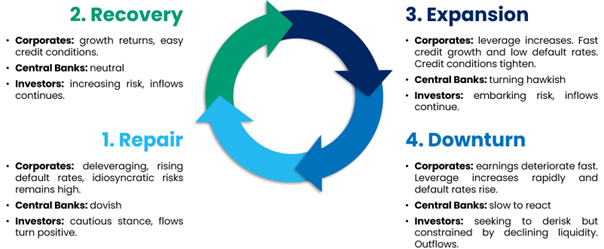
If you ask a fixed income investor to describe the credit cycle, most will readily cite its four familiar phases: Repair, Recovery, Expansion and Downturn. Knowing the terminology is straightforward. The more relevant question is: why does it matter for portfolio outcomes?

Credit cycles are a primary driver of returns in fixed income. Yet they are often misdiagnosed, oversimplified, or identified only in hindsight. While precise timing is inherently uncertain, transitions between phases tend to exhibit recurring patterns in credit spreads, issuance dynamics, leverage trends, and liquidity conditions.

Charudatta Shende;
Charudatta Shende
Head of Client Portfolio Management Fixed Income and Fixed Income Strategist
In credit investing, the best time to manage risk is precisely when it feels unnecessary because markets appear comfortable.

The Credit Cycle at a Glance


Why the Cycle Matters for Portfolio Management

More than labels, what matters is the evolving nature of risk embedded within each phase. Behind each stage lie shifting refinancing conditions and liquidity dynamics—factors that directly influence spread compensation, default risk, and dispersion across issuers and sectors. Our research paper moves beyond theory. It presents a disciplined framework for understanding the credit cycle and how to position portfolios accordingly.

Discover the main take-aways of the paper in this short video  

Tame Risk.

Don't run from it. 

Unternehmensanleihen wirken vielleicht entspannt, weil ihre Renditen meistens stabil sind. Aber Unternehmensanleihen sind asymmetrisch: Das Ertragspotenzial beschränkt sich auf die Zinsen, während das Verlustrisiko von Dauer sein kann, wenn sich die Fundamentaldaten abschwächen oder die Liquidität verschwindet.

Mehr lesen

Schnellsuche

Schnellerer Zugriff auf Informationen mit einem einzigen Klick

Erhalten Sie Einblicke direkt in Ihren Posteingang