


The Fed has delivered a hike where investors just months ago expected cuts. Markets now anticipate further tightening through 2027, yet US equities remain higher this year. Earnings expectations have held up through the reversal in monetary expectations. The upcoming Q3 reporting season will show whether companies can deliver on them.
We have increased our US equity allocation, moving to a slight overweight in the region. A positive view on the Technology sector and improving profit prospects support that decision. How much further monetary policy tightens will help determine whether those profits can compensate for the pressure on valuations.
Increased US equity allocation
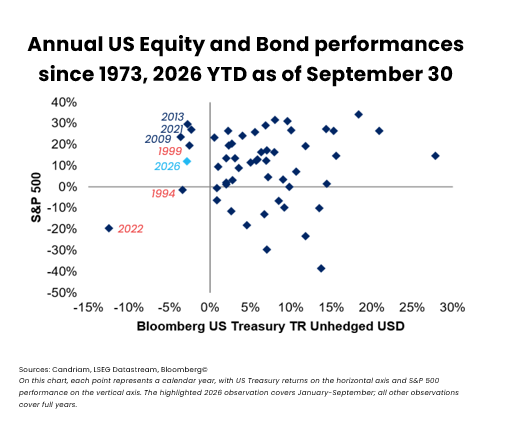
At the start of the fourth quarter, the equity/bond contrast is striking: the S&P 500 has gained around 12% through September, while US Treasuries have lost roughly 3%. Plotted against annual returns since 1973, that combination has only seven precedents. Equities also rose while Treasuries fell in 1999 and 2013; in 1994 they finished close to flat, while 2022 brought losses in both. Bond losses alone tell us little about how much pressure equities can withstand.
The tightening largely in the price
Investors entered the year expecting roughly 60 basis points of Fed easing by December 2026. Expectations for both end of 2026 and end of 2027 have since shifted towards hikes, with September’s realised 25-basis-point increase adding to the adjustment. The assumed cost of capital has changed substantially.
The speed of that change matters. A sharp rise in yields reduces the present value of future profits before companies can demonstrate any improvement in their operations. Even rising earnings estimates can struggle to offset the immediate valuation pressure, as we have seen in recent weeks.
The historical comparison below follows equities around unusually sharp increases in ten-year Treasury yields. The initial weakness gave way to a pronounced recovery in the more moderate episodes. Yield shocks associated with the forceful Fed monetary policy tightening cycles of 1994, 1999 and 2022 produced a much less favourable average path.
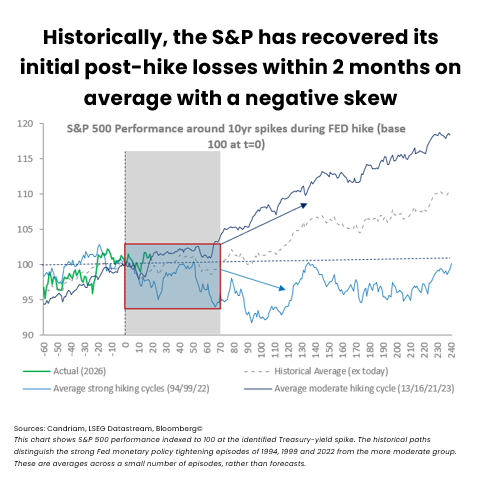
The dividing line is the effect on profits. Higher rates remain manageable while demand expands and companies grow their revenues. Sustained tightening reaches refinancing costs, investment decisions and household spending. If earnings estimates stop rising or even decline, they compound the damage from lower valuations. A market that initially looked cheaper can become less attractive.
In the current episode, markets already anticipate substantial tightening. That reduces the scope for surprise without removing the economic burden if those hikes materialise. Our central economic scenario remains one of limited additional tightening and US growth close to its potential. Downward revisions to US core PCE inflation have given the Fed some breathing room, while higher long-term yields are already restraining financing conditions. An October pause would allow policymakers to assess that transmission after September’s hike.
We note that US real yields have risen sharply while inflation expectations have remained comparatively contained. Stronger activity and investment demand help explain the move and support corporate revenues. Heavy debt issuance and a rising term premium add pressure without necessarily improving the profits available to meet higher financing costs.
Even a Fed pause would therefore leave companies facing expensive capital. The case for equities rests on their ability to grow through those conditions. Renewed inflation pressure or another abrupt rise in yields would therefore make that case harder to sustain.
Delivery takes precedence
US corporate investment is broadening beyond AI into conventional equipment, while household consumption continues to expand. This provides a firmer revenue base, but the upcoming reporting season must establish how much of it reaches profits after higher costs.
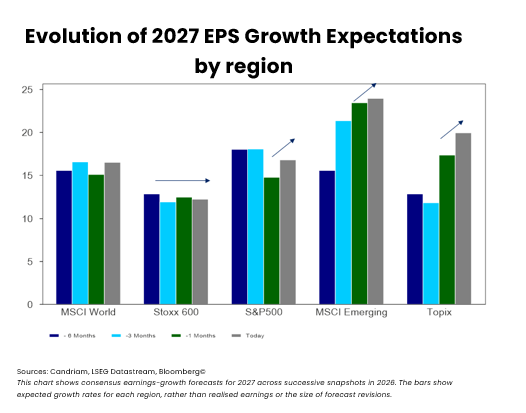
The positive profit growth expectations extend well beyond the next quarter. Consensus forecasts point to 2027 earnings growth of roughly 17% for the S&P 500, 24% for emerging markets and 20% for Japan, against around 12% for Europe. Recent upgrades have been particularly pronounced in Japan and emerging markets. These forecasts support our regional preferences but also establish a demanding standard for delivery.
Technology accounts for a substantial share of improving profit expectations, making its results particularly consequential. AI spending commitments need to translate into revenues and cash generation. However, another increase in investment budgets will offer only limited reassurance unless the expected returns become more tangible.
Guidance will reveal whether margins can withstand higher costs and whether customers are maintaining spending plans. Market reactions will be equally instructive. Strong results that fail to support share prices would suggest that investor expectations have moved ahead of delivery. This takes place in an environment where concentrated earnings leadership leaves less room for disappointment among the businesses carrying the index.
That dependence extends into the economy. Equity wealth, largely driven by the Tech sector in recent years, has helped US households sustain consumption despite slower wage growth and rising prices. A lasting market correction could weaken spending and feed back into corporate revenues. In a nutshell, earnings delivery matters both for today’s valuations and for the demand assumed in tomorrow’s forecasts.
Our technology-healthcare barbell addresses this concentration. Technology captures investment-led profit growth; healthcare adds demand less dependent on capital spending. Both compare favourably across the moderate and stronger tightening episodes. Healthcare also held up better during the recent rise in yields than utilities and consumer staples, giving the defensive allocation less dependence on falling rates.
Europe needs more than just a rebound
Europe has already suffered a sizeable equity decline during the recent rate shock. Historical comparisons point to substantial recovery potential if subsequent tightening remains moderate. On that basis, its weaker economic outlook does not rule out a stronger market recovery from a depressed starting point.
But political and fiscal concerns stand in the way. Wider sovereign spreads across the region raise borrowing costs without improving corporate demand. German public spending supports activity, but fiscal worries elsewhere limit the regional impulse. Stabilising spreads and firmer private demand would strengthen the case. We remain neutral for now, alongside maintained equity preferences for Japan and emerging markets.
The same European constraints support our preference for core sovereign duration, which can balance equity exposure if regional growth disappoints. Credit offers less upside from stronger profits once spreads are tight, while borrowers still face higher refinancing costs. We remain selective and cautious on US high yield, with a positive view on emerging-market local-currency debt.
Gold retains a role in diversification, although rising real yields can limit its near-term contribution. It should not be expected to offset every setback in equities, particularly one driven by another rates shock.
Our higher US equity allocation therefore sits alongside core European duration and a broader mix of earnings sources. Continued delivery would support retaining the additional risk; weaker profit guidance alongside persistent inflation would call for reducing it. Entering the final quarter, we are willing to carry an overweight equity exposure, with protection spread across assets rather than resting on an early return to Fed easing. In a few weeks, we will know, if Wall Street can again cheer the corporate earnings season, as it did over the previous quarters.
Candriam House View & Convictions
The table below is an indicator of the main exposures and movements within a balanced diversified model portfolio.
Legend
-
Strongly Positive
-
Positive
-
Neutral
-
Negative
- Strongly Negative
- No Change
- Decreased Exposure
- Increased Exposure
| Current view | Change | |
|---|---|---|
| Global Equities |
|
|
| United States |
|
|
| EMU |
|
|
| Europe ex-EMU |
|
|
| Japan |
|
|
| Emerging Markets |
|
|
| Bonds |
|
|
| Europe |
|
|
| Core Europe |
|
|
| Peripheral Europe |
|
|
| Europe Investment Grade |
|
|
| Europe High Yield |
|
|
| United States |
|
|
| United States |
|
|
| United States IG |
|
|
| United States HY |
|
|
| Emerging Markets |
|
|
| Government Debt HC |
|
|
| Government Debt LC |
|
|
| Currencies |
|
|
| EUR |
|
|
| USD |
|
|
| GBP |
|
|
| AUD/CAD/NOK |
|
|
| JPY |
|
Monthly Coffee Break
Updated each month, this section provides expert analysis and strategic insights. Stay informed with our latest market perspectives and allocations.
-
 Monthly Coffee Break, Alternative Investments
Dispersion and Trends Drive Opportunities
September was characterised by resilient global economic activity, persistent inflationary pressures and increasing concerns over monetary tightening and geopolitical risks. In the United States, economic momentum remained robust, supported by AI-related investment and resilient consumption, despite signs of labour market moderation. In Europe, economic indicators continued to improve, with manufacturing and services PMIs signalling greater resilience. -
 Monthly Coffee Break, Asset Allocation
Earnings take centre stage
The Fed has delivered a hike where investors just months ago expected cuts. Markets now anticipate further tightening through 2027, yet US equities remain higher this year. Earnings expectations have held up through the reversal in monetary expectations. The upcoming Q3 reporting season will show whether companies can deliver on them. -
 Monthly Coffee Break, Fixed Income
Maintaining duration overweight on EUR rates
We retain a modest duration overweight in the two-to-five-year segment after September's sharp sell-off. Higher real yields have made valuations more appealing, but we keep conviction limited. Our strongest argument remains monetary policy: markets discount a terminal Fed rate around 4.75% , leaving room for a less extensive tightening cycle to support shorter maturities. -
 Monthly Coffee Break, Equities
The earnings test
After a period in which strong earnings helped equities absorb rising interest rates, higher bond yields have begun to weigh more on equity sentiment. The third-quarter reporting season will now test whether companies can sustain market confidence through solid results and credible guidance. Earnings expectations continue to rise, providing an encouraging starting point, while also raising the bar for companies to deliver.