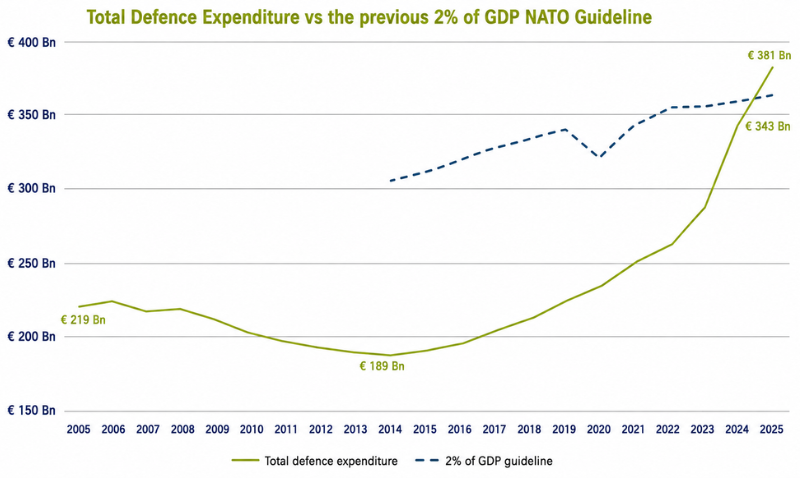
Source: European Defence Agency, Defence Data 2024-2025
For investors, several long-duration cycles are emerging, each with different potential beneficiaries. Identifying them requires looking beyond spending targets to the companies capable of delivering.
Europe’s security reset
In 2025, NATO allies committed to raise total defence and security-related spending to 5% of GDP by 2035, split between 3.5% on core military capabilities and 1.5% on broader resilience areas such as cyber and infrastructure. The Ankara summit a year later shifted the focus from commitments to implementation[1]. Announcements at the summit included:
- More than $50 billion of new procurement
- $40 billion in counter-drone investments
- Pledged €70 billion in military assistance to Ukraine for 2026-2027
- Five member states, led by the Baltics and Poland, already exceed the 3.5% core defence target
Financing autonomy: from pledges to procurement
Turning political commitments into military capability requires money, and the EU has spent the past eighteen months building the financial architecture to support it. The European Union is combining national investment, joint borrowing and grants to support a larger, more coordinated defence effort across the Bloc.
The Readiness 2030/ReArm Europe[2] package, presented in March 2025, aims to mobilise up to €800 billion in additional defence investment through a combination of national fiscal flexibility, EU funds and private capital.
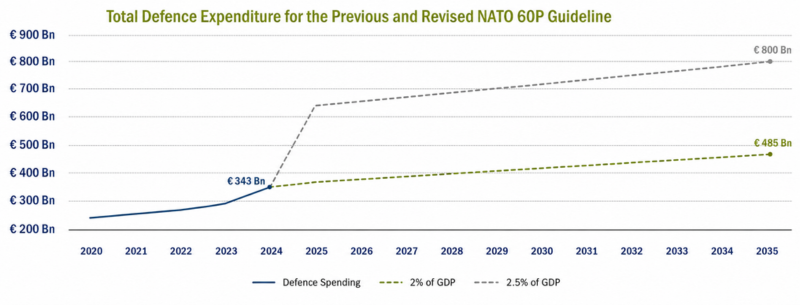
Source: European Defence Agency, Defence Data 2024-2025
The EU’s most visible pillar is SAFE (Security Action for Europe)[3], a €150 billion loan facility for joint procurement that attracted demand in excess of the available funding from the 19 participating member states.
Disbursements began in 2026, and loan-funded contracts must source at least 65% of their components from the EU, Ukraine or EEA/EFTA countries, reinforcing a “buy European” principle.
Alongside SAFE, the European Defence Industry Programme [4](EDIP) provides €1.5 billion in grants for 2025-2027, a modest sum but a template: the European Commission has proposed folding defence and space into a dedicated €131 billion[5] envelope within the 2028-2034 EU budget, a scale that would have been unthinkable a few years ago.
While higher budgets provide a supportive backdrop, funding will not flow evenly. Opportunities are likely to be found in companies that can already produce efficiently and at scale.
The key constraint (for now): execution
The clearest evidence that European defence has entered a genuine industrial expansion cycle lies in the order books of its prime contractors, which have increased severalfold across all domains (from land to air including legacy and new warfare systems). Across the largest listed European primes, revenue has grown by an average of 57% since 2021.[6]
However, execution – in the form of parts, labour and factory capacity - is now the binding constraint. Industry executives have publicly pushed governments for firmer, faster contracting to justify the capital being committed to new plants. The stalled Franco-German FCAS next-generation fighter programme[7], and the recent cancellation of a German frigate order[8], are reminders that political alignment and procurement speed remain the main obstacles standing between capital commitments and delivered capability, more than financing or demand.
We believe more resilient candidates are likely to combine strategically important products with credible production plans, disciplined contracting and manageable programme risk. In this sector, fundamental company analysis remains as important as the overall theme.
Civil aerospace: European autonomy already established
In civil aerospace Europe is home to one of only two companies in the world capable of producing large commercial jets at scale, and global demand has rarely been stronger. Demand is not the constraint. The combined backlog for large commercial aircraft exceeds 16,000, equivalent to around 12 years of production. The challenge is output: engine shortages and wider supply-chain bottlenecks in forgings, castings and titanium have repeatedly delayed production increases.
Engine technology is where Europe’s civil aerospace autonomy is most tangible. CFM International, the 50/50 joint venture between Safran and GE Aerospace, powers more than 60% of the global narrowbody fleet[9], including, through its Leap-1C variant, China’s own C919, a reminder that seven China’s flagship aircraft programme still relies on Franco-American propulsion technology.
Civil aerospace offers a different cycle from defence, driven by fleet replacement, passenger demand, and recurring maintenance and parts revenue. As in defence, we see particular value in suppliers the financial and logistical capabilities to fund and achieve increased production.
Space: the next strategic infrastructure
Europe's autonomy challenge increasingly extends into orbit. Satellite communications, navigation and earth observation support civilian infrastructure, military operations and emergency response, yet Europe still depends in several areas on non-European technology and constellations.
Industrial consolidation efforts, together with public programmes such as Galileo, Copernicus and the IRIS2 secure-connectivity constellation, are intended to strengthen European capacity. The opportunity extends beyond satellite manufacturers to components, secure communications, data processing, ground systems and launch services.
In our view, the more resilient businesses will be those serving both government and commercial customers. Dual-use exposure can reduce dependence on any single programme while preserving participation in Europe's autonomy agenda.


