


Real estate markets, and real estate investing, have felt ‘frozen’ for most of 2023. Property valuations are under pressure and refinancing is more difficult. Yet under the ice, investors and managers have been positioning for a warmer season.
Property under Pressure
With volumes plummeting due to the rapid rise in interest rates, transaction numbers in Europe are struggling to reach 20% of their pre-pandemic levels.[1] With the market starved of pricing information, over the last 18 months, valuers and appraisers have largely based property price estimates on interest rate changes. The scale and volatility of credit costs has meant that in most sectors, capitalisation rates have increased significantly, driving down appraised values. The magnitude of the mark-downs has been somewhat mitigated by the relative strength of the leasing/rental markets, and by indexation arrangements which have actually increased net operating income.
While prices have declined across the market, the magnitude has differed by sub-segment. Some segments are near a bottom, while others are likely to see further price declines.
Prime European central business district rental yields were about 4.5% for the first half of 2023, up 86 bps over the year-prior period, according to Savills.
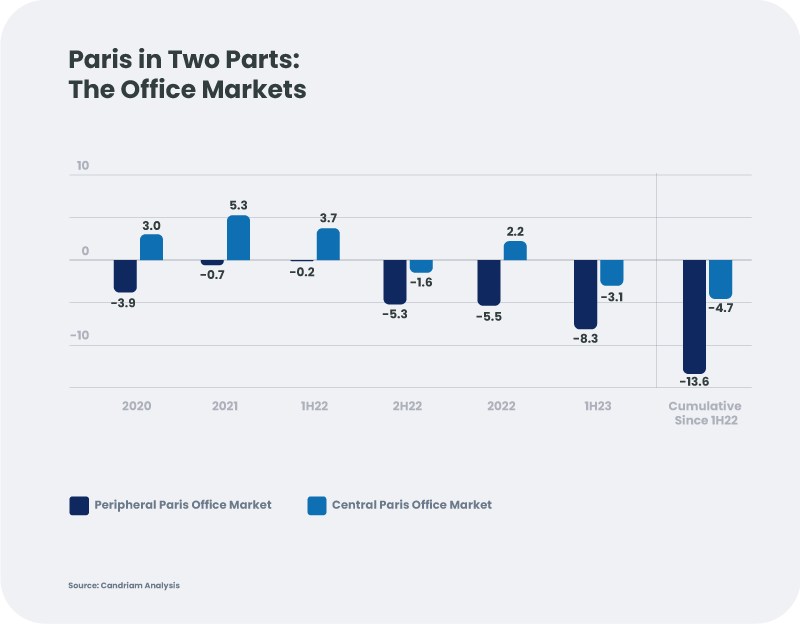
The recent Greater Paris office market has bifurcated, with Central Paris valuations declining in the mid-single-digit range, while peripherical regions have seen mid-double-digit declines since mid 2022, albeit from different base levels. Average net initial yields reached 6.5% in la Défense, while prime Central Paris business district assets reported rental yields of about 3%.
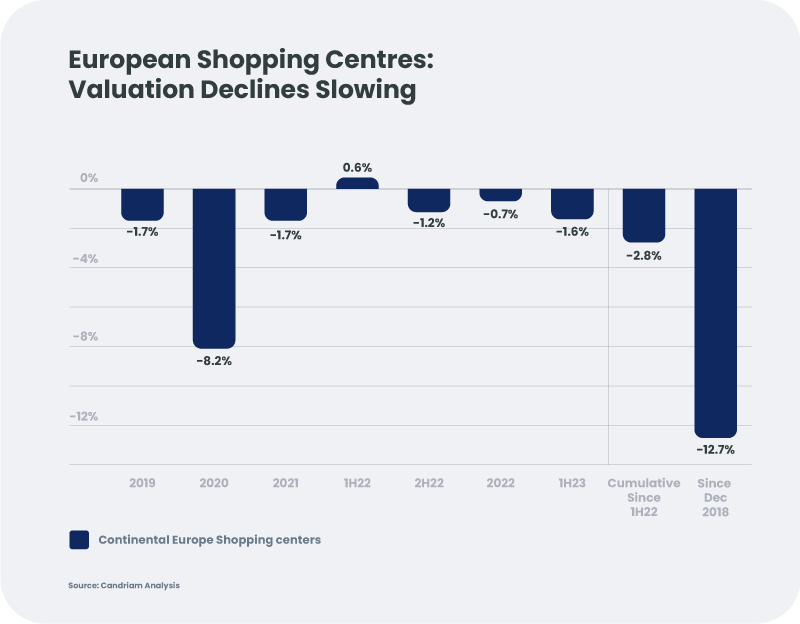
Retail landlords in Europe have faced greater property valuation losses than most other segments. Since the first half of 2022, valuations of prime shopping centres in continental Europe have declined only about -3%, while they have fallen about -15% since 2018 and now offer net initial yields of about 5.5% as of H1 2023.
Refinancing needs high, but lenders are shy
One result of the slow pace of transactions has been a surge in refinancing. Those in need of refinancing have turned to private capital sources in particular. Bank lending appetite has fallen dramatically while banking regulatory changes are biting. Issuers have responded to the lack of appetite for senior unsecured debt by offering security to banks.
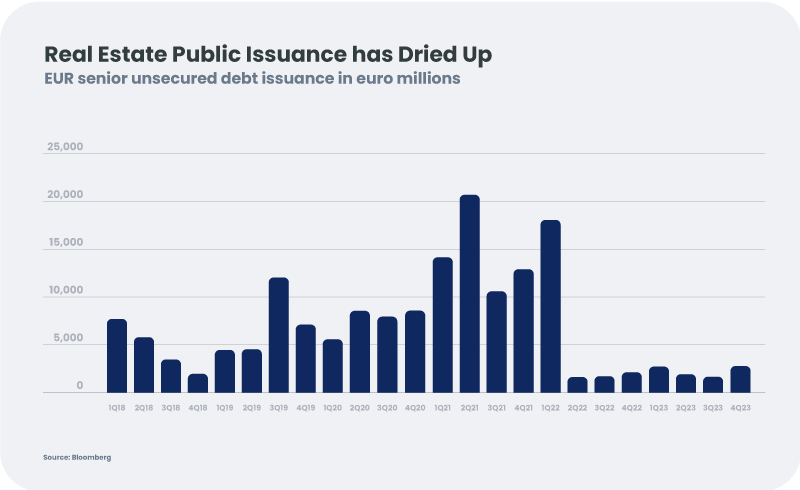
As to publicly traded debt for refinancings, the senior bond market had been virtually closed to most real estate issuers since the second quarter of 2022, as shown in the graph. We have recently seen some ‘green shoots’ – a few large issuers such as Covivio and Unibail-Rodamco-Westfield have returned to the primary market, with investors showing strong appetite for these new issues.
With such large refinancing needs, the priority has shifted to cash preservation including dividend cuts, postponing calls of hybrid debt, and asset disposals.
Fundamentals – Looking to the Long Term
Long-term factors are supporting operating performance of the sector. Rents are beginning to turn up in Europe, and vacancy is down. For those managers with the best space, such as strong “green” credentials, good amenities, and location, the occupier appetite is robust and rising. Indexation clauses in leases and low levels of vacancy in high-quality assets have supported rents and, in some sectors, we have seen significant growth in incomes. This has reduced the impact of higher capitalisation rates, and valuations of properties are beginning to stabilize.
German residential market fundamentals are at their strongest point for decades – a surprise for some. Europe’s largest market (in terms of investment) is experiencing its greatest supply/demand mismatch in at least a generation. Ask the tenants seeking a home; they are facing ultra-low vacancy rates. Lower supply, constrained both by higher construction and financing costs, is insufficient to meet increased demand from strong demographic trends, increasing the ‘gap’ in the German housing market.
Office space has been disrupted by the work-from-home trend, with tenants seeking sustainable buildings, and generally “better square meters”. This flight to quality has resulted in prime assets being more resilient than secondary assets.
Logistics assets continue to enjoy strong demand, albeit normalizing after pandemic surge. The lack of appropriate locations, difficulty in obtaining building permits, E-commerce growth, and the appetite for supply chain onshoring should continue to drive growth over the longer term.
Shopping centres, along with other brick-and-mortar retail, have long suffered from E-commerce, followed by the pandemic. Valuations were cut even before interest rates began to rise. European shopping centre fundamentals are benefitting from the post-pandemic recovery, and with higher rental yields than other segments, they are less sensitive to higher interest rates (as long as operational performance continues).
Capital markets
With capital structures squeezed, well-capitalised real estate investors sense an opportunity. A handful of key players have raised capital, so there is significant funding in place for investment across a range of real estate segments. Further, some real asset owners with higher risk appetites are considering returning to some sub-sectors which were highly-leverage during the last leg of the upcycle, particularly in Germany and Sweden, and we are already seeing significant recapitalisation opportunities.
The wisest real estate companies took advantage of the low interest rates to extend their maturity profiles at very low cost. In the new interest rate environment the focus has shifted to net leverage and interest coverage ratios.
This could translate into opportunities for several investment asset classes. Equity markets have severely penalized real estate companies, making some of those with lower leverage and/or longer debt maturities attractive. All the better if companies have sound operations with free cash flow.,
In publicly-traded debt, yields of 5%-6% combined with more typical levels of issuance could make 2024 a pivotal year especially if interest rates stabilize and transactions rebound. This type of environment should favour high-quality issuers with healthy balance sheets and good operating performance.
We see an opportunity for private capital, especially if real estate values are near their floor. The combined effect of rates and spreads has lifted the potential returns on senior secured loans to “equity-like”. It is very rare for European private debt investors to be both paid this well and to have such an open playing field to work on.
This market is no longer cold as ice.
Conclusion
While the real estate market may still seem ‘frozen’ as we head into winter, key players are not hibernating. The sector offers opportunities for risk-aware participants. Capital providers and investors can now use the uncertainty and volatility of the last two years to their advantage, providing they do their homework.
Is 2024 the year in which the “freeze” turns into the ‘thaw’?
This communication is provided for information purposes only, it does not constitute an offer to buy or sell financial instruments, nor does it represent an investment recommendation or confirm any kind of transaction, except where expressly agreed. Although Candriam selects carefully the data and sources within this document, errors or omissions cannot be excluded a priori. Candriam cannot be held liable for any direct or indirect losses as a result of the use of this document. The intellectual property rights of Candriam must be respected at all times, contents of this document may not be reproduced without prior written approval.
[1] Real Capital Analytics.
-

Can Europe build its way to energy autonomy?
Europe may be breaking its dependence on Russian fossil fuels, but energy autonomy will not be achieved by changing the energy mix alone. It will require stronger grids, greater industrial capacity and more resilient critical-material supply chains. -

Dispersion and Trends Drive Opportunities
September was characterised by resilient global economic activity, persistent inflationary pressures and increasing concerns over monetary tightening and geopolitical risks. In the United States, economic momentum remained robust, supported by AI-related investment and resilient consumption, despite signs of labour market moderation. In Europe, economic indicators continued to improve, with manufacturing and services PMIs signalling greater resilience. -

Earnings take centre stage
The Fed has delivered a hike where investors just months ago expected cuts. Markets now anticipate further tightening through 2027, yet US equities remain higher this year. Earnings expectations have held up through the reversal in monetary expectations. The upcoming Q3 reporting season will show whether companies can deliver on them. -

Maintaining duration overweight on EUR rates
We retain a modest duration overweight in the two-to-five-year segment after September's sharp sell-off. Higher real yields have made valuations more appealing, but we keep conviction limited. Our strongest argument remains monetary policy: markets discount a terminal Fed rate around 4.75% , leaving room for a less extensive tightening cycle to support shorter maturities. -

The earnings test
After a period in which strong earnings helped equities absorb rising interest rates, higher bond yields have begun to weigh more on equity sentiment. The third-quarter reporting season will now test whether companies can sustain market confidence through solid results and credible guidance. Earnings expectations continue to rise, providing an encouraging starting point, while also raising the bar for companies to deliver. -

Identifying Climate Risk in Credit
When climate indices disagree, is the gap simply noise - or a risk that credit markets price? This paper connects academic research with investment practice to explore climate beta uncertainty in US and European corporate bonds. -

The AI debt wave
AI’s infrastructure boom is drawing some of the world’s largest technology companies deeper into debt markets. -

Effective Leadership: Is your board prepared for the next leadership challenge?
Leadership transitions can affect strategy execution, organisational stability, investor confidence and long-term value creation. Yet effective leadership governance goes beyond selecting the right CEO today. Boards also need to anticipate the leadership capabilities their company will require for its next strategic phase.