After a period in which strong earnings helped equities absorb rising interest rates, higher bond yields have begun to weigh more on equity sentiment. The third-quarter reporting season will now test whether companies can sustain market confidence through solid results and credible guidance. Earnings expectations continue to rise, providing an encouraging starting point, while also raising the bar for companies to deliver.
Higher rates aren’t necessarily bad news
In September, we highlighted how earnings growth had allowed equities to absorb higher long-term interest rates. Since then, the US 10-year yield has moved above the 5% level[1] discussed in our previous house view, putting additional pressure on valuations.
The reason for the increase matters. When higher rates reflect a stronger economy, improving revenues and earnings can compensate for the valuation headwind. The Fed’s September decision came alongside an assessment of solid activity, resilient spending and robust investment. We see this as a signal of economic strength, even as persistent inflation requires a policy response.
Even a new tightening cycle totalling around 100 basis points would not automatically undermine the equity outlook, provided growth and earnings remain resilient. Historically, initial volatility after the first Fed hike has often given way to positive equity returns over the following six to 12 months. The economic backdrop and the pace of tightening remain decisive.
Earnings face their next test
The earnings season now offers an opportunity to reassess the balance between interest rates and earnings growth. Consensus expected S&P 500 third-quarter earnings growth of 29.5%, up from 26.7% at the end of June. Energy, Information Technology and Financials led the upward revisions, with higher energy prices and strong AI-related demand supporting the first two sectors. All 11 S&P 500 sectors are expected to deliver year-on-year earnings growth.[2]
These expectations provide a solid foundation but leave companies with more to deliver. Beyond quarterly results, investors will look closely at management guidance to assess whether demand and margins can sustain earnings growth into 2027. Confirmation that the improvement extends across a wider range of businesses would strengthen the market’s ability to withstand higher yields.
Looking beyond headline growth
The sources of earnings growth will also deserve attention. Higher oil prices support energy profits but increase costs elsewhere. AI investment generates revenue for semiconductor and equipment suppliers, while the companies funding that infrastructure must demonstrate how the spending translates into revenue and future returns. For banks, lending activity, funding costs and credit quality will help determine whether profitability remains resilient.
In this context, differences in earnings visibility and valuations reinforce the importance of selectivity. Within our preferred sectors, we select companies whose earnings prospects justify their valuation and whose financial resources allow them to execute their investment plans. A constructive earnings backdrop continues to support equities, with stock selection central to capturing that growth.
From market drivers to portfolio positioning
Regional equity markets are entering the earnings season from very different starting points. The United States continues to benefit from strong earnings and technology leadership, Europe faces greater pressure from higher yields and weaker market breadth, while emerging market returns remain strong but concentrated in technology. These differences favour a selective regional approach focused on earnings visibility, valuations and sustainable growth drivers.
United States
US equities have remained resilient despite higher long-term yields, geopolitical uncertainty and elevated oil prices, with the Nasdaq Composite reaching a new all-time closing high in early October.[3] September’s performance was uneven, with gains concentrated in large-cap technology and communication services stocks, while much of the broader market declined. Large-cap growth outperformed value, while mid- and small-cap equities fell.[4]
Third-quarter earnings expectations remain strong, supported by upward revisions. With this optimism already reflected in expectations, credible management guidance and the ability to deliver on forecasts will be key to sustaining market confidence.
Our sector positioning reflects three main convictions:
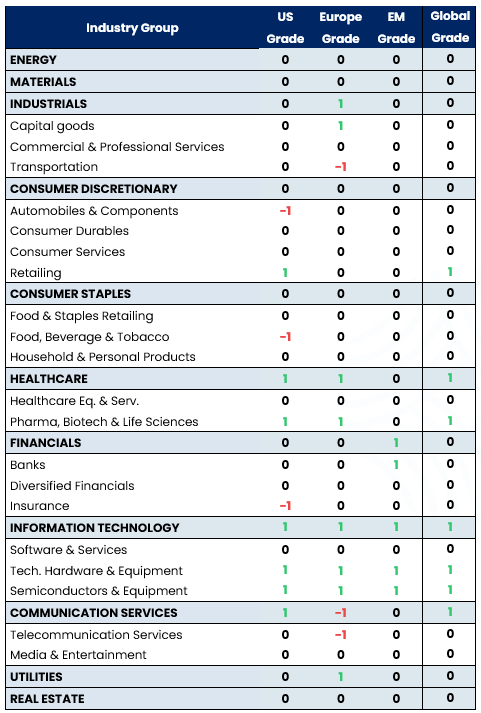
- Healthcare remains one of our highest-conviction sectors, with a particular focus on biotechnology. Continued innovation, M&A activity and strong earnings growth expectations support our positive stance.
- Information Technology was upgraded to a strategic overweight at the end of September, including semiconductors and equipment, and technology hardware and equipment. Strong earnings momentum and continued AI infrastructure investment underpin our conviction. Meta’s launch of Muse illustrates how consumer adoption of AI could broaden demand beyond enterprise applications. If adoption develops as expected, additional compute, memory and connectivity requirements should support the broader AI infrastructure ecosystem.
- Communication services has also been upgraded to overweight. We see large digital platforms as potential beneficiaries of consumer agentic AI. Their extensive user bases and established distribution could help them turn greater adoption into additional revenues, although the pace and profitability of monetisation remain important points to monitor.
Europe
European equities have declined slightly since our last Committee, as rising global government bond yields weighed on sentiment and valuations.[5] Conflict in the Middle East and higher oil prices added to inflation concerns, while widening sovereign yield spreads and fiscal uncertainty in France created further pressure.
Information Technology was the only sector to advance over the period, supported by optimism about AI investment and demand for semiconductors. Real Estate was the weakest performer, as higher yields weighed on the sector, while Financials also declined.
Against this backdrop, the Committee made three changes to its positioning:
- Banks and Financials have been downgraded to neutral from overweight. Bank fundamentals remain sound, but heightened political uncertainty and less compelling valuations following the sector’s strong performance warrant a more balanced stance.
- Telecommunication Services and Communication Services have been downgraded to underweight from neutral. Competitive and pricing pressures, modest growth prospects and less compelling valuations weigh on the investment case. AI agents could add to these pressures by making it easier for consumers to compare offers and switch providers. Our more cautious view contrasts with our US overweight, where digital platforms drive the sector conviction.
- Transportation has been downgraded to underweight from neutral. Additional freight capacity and limited demand visibility increase the risk of pressure on pricing and profitability.
All other sector views remain unchanged. We continue to favour Healthcare, Information Technology, Utilities and Industrials.
Within Healthcare, our preference remains for pharmaceuticals, biotechnology and life sciences. In Information Technology, our conviction remains supported by expected semiconductor capacity additions and continued investment in AI.
Our positive view on Utilities reflects structural demand from electrification and grid investment, alongside reasonable valuations. Within Industrials, we favour capital goods companies exposed to power generation, electrification and grid modernisation. Large order backlogs also support our positive view on aerospace.
Emerging markets
Despite some consolidation in September, Emerging markets delivered strong year-to-date performance. Market leadership remains exceptionally narrow, with the Technology sector leading the returns. Outside Technology, the environment has been more challenging, reflecting higher oil prices, rising inflation expectations and a stronger US dollar, alongside a less supportive macroeconomic backdrop in major economies such as China and India.
- Sector performance remains highly differentiated. Technology continues to lead the market and remains the main source of strength, while Materials has been the weakest performing sector.[6] Consumer-related areas have also struggled, particularly in China. By contrast, Banks have proven relatively defensive, notably in China and India, offering some resilience against the more challenging macroeconomic backdrop.
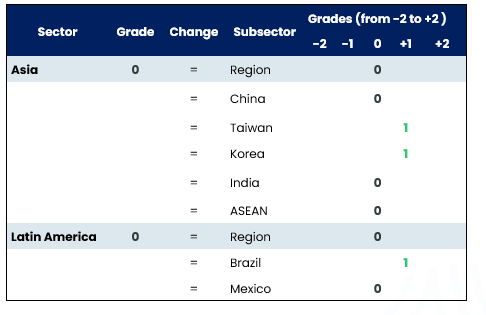
- Brazil remains a key overweight and a differentiated conviction call. The overweight position in Brazil, which was initially non-consensus, has benefited from a strongly positive market reaction to the first round of elections, with MSCI Brazil gaining almost 15%.[7] High trading volumes following the result suggest investors are increasingly chasing the move, while broker upgrades could provide additional support. The upcoming run-off remains the key near-term catalyst, with the market likely to anticipate a Bolsonaro victory as far as possible ahead of the final result.
- Political change could become a broader catalyst for Latin America. Brazil fits into a wider regional trend of political transition across Latin America. Recent changes in countries including Argentina, Peru and Colombia have been followed by positive equity market reactions. A similar dynamic could support Brazil, particularly given its status as a relatively neglected market over much of the past two decades.
Global convictions
The table below summarises our current highest-conviction regional, country and sector positioning following the latest Strategic Equity Committee.
[1] Source: Bloomberg, 7 October 2026
[2] Source: Bloomberg, 2 October 2026
[3] Source: Bloomberg, 2 October 2026
[4] Source: Bloomberg, 2 October 2026
[5] Source: Bloomberg, 2 October 2026
[6] Source: Bloomberg, 7 October 2026
[7] Source: Bloomberg, 2 October 2026


