Message important : Attention aux escroqueries par usurpation d'identité

Des messages et des publicités frauduleuses circulent actuellement sur les plateformes de messagerie, y compris WhatsApp, en usurpant l'identité de la marque Candriam et de ses employés. Veuillez noter que Candriam n'offre jamais de recommandations d'investissement ou de conseils financiers par le biais de canaux tels que les médias sociaux ou les plateformes de messagerie.

A Practical Framework for Fixed Income Investors

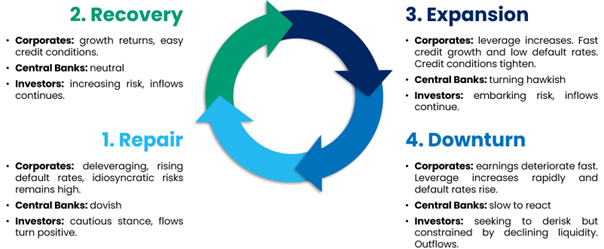
If you ask a fixed income investor to describe the credit cycle, most will readily cite its four familiar phases: Repair, Recovery, Expansion and Downturn. Knowing the terminology is straightforward. The more relevant question is: why does it matter for portfolio outcomes?

Credit cycles are a primary driver of returns in fixed income. Yet they are often misdiagnosed, oversimplified, or identified only in hindsight. While precise timing is inherently uncertain, transitions between phases tend to exhibit recurring patterns in credit spreads, issuance dynamics, leverage trends, and liquidity conditions.

Charudatta Shende;
Charudatta Shende
Head of Client Portfolio Management Fixed Income and Fixed Income Strategist
In credit investing, the best time to manage risk is precisely when it feels unnecessary because markets appear comfortable.

The Credit Cycle at a Glance


Why the Cycle Matters for Portfolio Management

More than labels, what matters is the evolving nature of risk embedded within each phase. Behind each stage lie shifting refinancing conditions and liquidity dynamics—factors that directly influence spread compensation, default risk, and dispersion across issuers and sectors. Our research paper moves beyond theory. It presents a disciplined framework for understanding the credit cycle and how to position portfolios accordingly.

Discover the main take-aways of the paper in this short video  

Domptez le risque.

Ne le fuyez pas. 

Le marché obligataire peut sembler calme, car les rendements sont généralement stables. Mais le crédit est asymétrique : le potentiel de hausse se limite au coupon, tandis que le risque de baisse peut être permanent si les fondamentaux s’affaiblissent ou si la liquidité disparaît.

En savoir plus

Recherche rapide

Obtenez des informations plus rapidement en un seul click

Recevez des informations directement dans votre boîte e-mail