Messaggio importante: attenzione alle truffe di impersonificazione

Attualmente stanno circolando messaggi e annunci fraudolenti su piattaforme di messaggistica, tra cui WhatsApp, che si spacciano per i suoi professionisti degli investimenti e il marchio Candriam. Si prega di notare che Candriam non offre mai raccomandazioni di investimento né fornisce consulenza finanziaria tramite canali social o piattaforme di messaggistica.

A Practical Framework for Fixed Income Investors

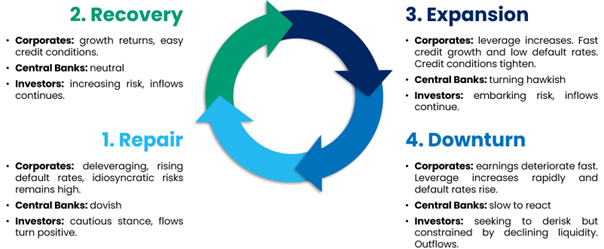
If you ask a fixed income investor to describe the credit cycle, most will readily cite its four familiar phases: Repair, Recovery, Expansion and Downturn. Knowing the terminology is straightforward. The more relevant question is: why does it matter for portfolio outcomes?

Credit cycles are a primary driver of returns in fixed income. Yet they are often misdiagnosed, oversimplified, or identified only in hindsight. While precise timing is inherently uncertain, transitions between phases tend to exhibit recurring patterns in credit spreads, issuance dynamics, leverage trends, and liquidity conditions.

Charudatta Shende;
Charudatta Shende
Head of Client Portfolio Management Fixed Income and Fixed Income Strategist
In credit investing, the best time to manage risk is precisely when it feels unnecessary because markets appear comfortable.

The Credit Cycle at a Glance


Why the Cycle Matters for Portfolio Management

More than labels, what matters is the evolving nature of risk embedded within each phase. Behind each stage lie shifting refinancing conditions and liquidity dynamics—factors that directly influence spread compensation, default risk, and dispersion across issuers and sectors. Our research paper moves beyond theory. It presents a disciplined framework for understanding the credit cycle and how to position portfolios accordingly.

Discover the main take-aways of the paper in this short video  

Doma il rischio.

Non scappare. 

Il credito può dare l’idea della tranquillità perché il più delle volte i rendimenti sono costanti. Ma il credito è asimmetrico: il rialzo è limitato alla cedola, mentre il ribasso può essere permanente se i fondamentali si indeboliscono o la liquidità scompare.

Continua a leggere

Ricerca rapida

Ottenere informazioni più velocemente con un solo clic

Ricevi approfondimenti direttamente nella tua casella di posta elettronica