
Technology: conviction beyond the correction
Following strong performance in recent years, the information technology sector and the broader AI trade are experiencing significant volatility.


Following strong performance in recent years, the information technology sector and the broader AI trade are experiencing significant volatility. Investors are increasingly weighing the risks surrounding the next phase of AI development. Yet demand remains strong, earnings expectations continue to rise and AI adoption is broadening.
Artificial intelligence is entering a more demanding phase. The scale of infrastructure spending has raised expectations, and investors increasingly want evidence that these commitments will generate compelling returns. This scrutiny can create opportunities when uncertainty overshadows progress in the underlying businesses.
In our view, three main risks are currently defining investor sentiment. The first concerns return on invested capital. Rapid technological change, shorter hardware lifecycles and competition from open-source models make the payback on AI infrastructure harder to predict. Growing usage must translate into sufficient profits to justify the investment.
The second relates to financing and free cash flow. Infrastructure spending is increasingly supported by debt, leases and external capital. A larger depreciable asset base can weigh on reported earnings, while capital expenditure and financing costs can constrain free cash flow.
The third concerns potential political constraints and power availability. The Democrats’ gains in the midterm elections could intensify scrutiny of electricity costs and the impact on local communities, potentially leading to tighter conditions for new data centres. Alongside grid bottlenecks, water availability and permitting delays, this may slow deployment, increase costs or shift investment towards other locations. The impact will vary considerably depending on project location and readiness. Our base case remains continued expansion of AI infrastructure, supported by a substantial near-term pipeline already under construction, while uncertainty is greater for projects planned further out.
Despite these uncertainties, recent results show continued strength in cloud services and AI computing demand. Investment is translating into revenue growth, while semiconductor and equipment suppliers have issued encouraging outlooks for 2027. The current earnings picture therefore remains supportive, even as investors question the longer-term returns.
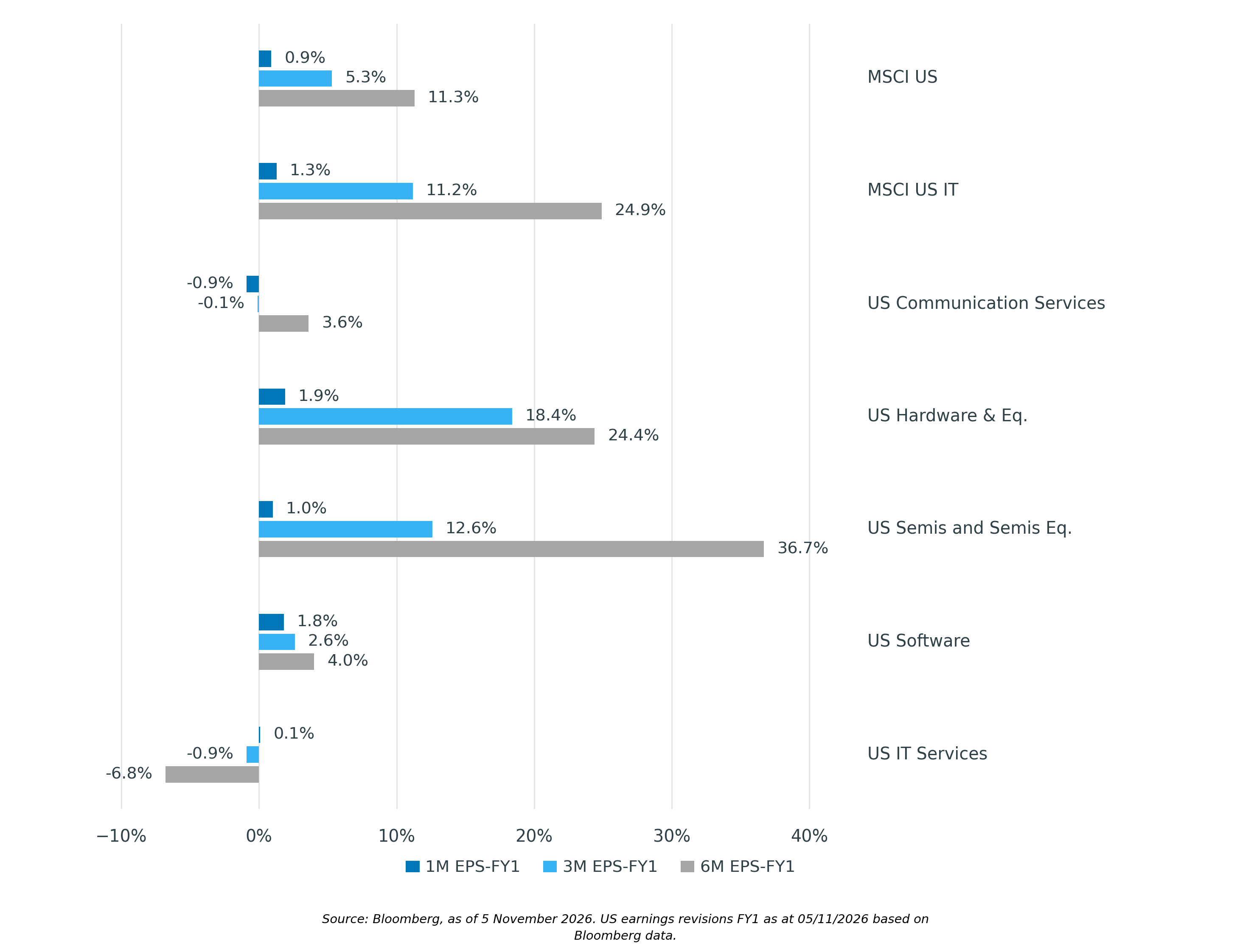
The divergence between share prices and earnings expectations is particularly relevant. Across several technology and AI segments, prices have fallen while profit forecasts have continued to rise, bringing valuations down. Expectations still need to be delivered, but this combination provides an interesting starting point for investors. Over the six months to 5 November 2026, next-year earnings forecasts rose more strongly for US information technology than for the broader US equity market, with particularly large upgrades in semiconductors and hardware.
US earnings forecast revisions: technology versus the broader market
AI’s potential extends well beyond infrastructure. Applications in software development, business automation and scientific research can generate new revenues and improve productivity. More efficient chips and lower computing costs could help broaden adoption and make more applications commercially viable.
At Candriam, we continue to see scope for technology to outperform the broader equity market. We remain positive on semiconductors and technology hardware, while taking a more selective approach to software. Integrated technology platforms also have several ways to monetise AI, through cloud services, existing products and improvements in their own operations.
The investment case will increasingly depend on companies turning adoption into sustainable earnings and cash flow. With demand remaining strong and valuations having adjusted, we believe the sector has scope to outperform the broader equity market, although this depends on companies meeting earnings expectations. In the near term, we will closely monitor the market’s response to Anthropic’s IPO on November 18, and the appointment of a new permanent CEO at Nvidia, following the interim appointment of Colette Kress. Selectivity will be more important than ever.


AI faces greater scrutiny: Investment returns, financing requirements and power availability remain key risks.
Earnings offer support: Upward profit revisions underpin our conviction, although trends vary across technology segments.
Selectivity remains essential: We favour semiconductors and hardware, with a more selective approach to software.
Explore the structural trends shaping AI, automation and digital infrastructure in Candriam’s research on disruptive technologies.


Schnellerer Zugriff auf Informationen mit einem einzigen Klick