

Portfolio decarbonisation may look good on paper. Now is the time to ground it in the real economy.
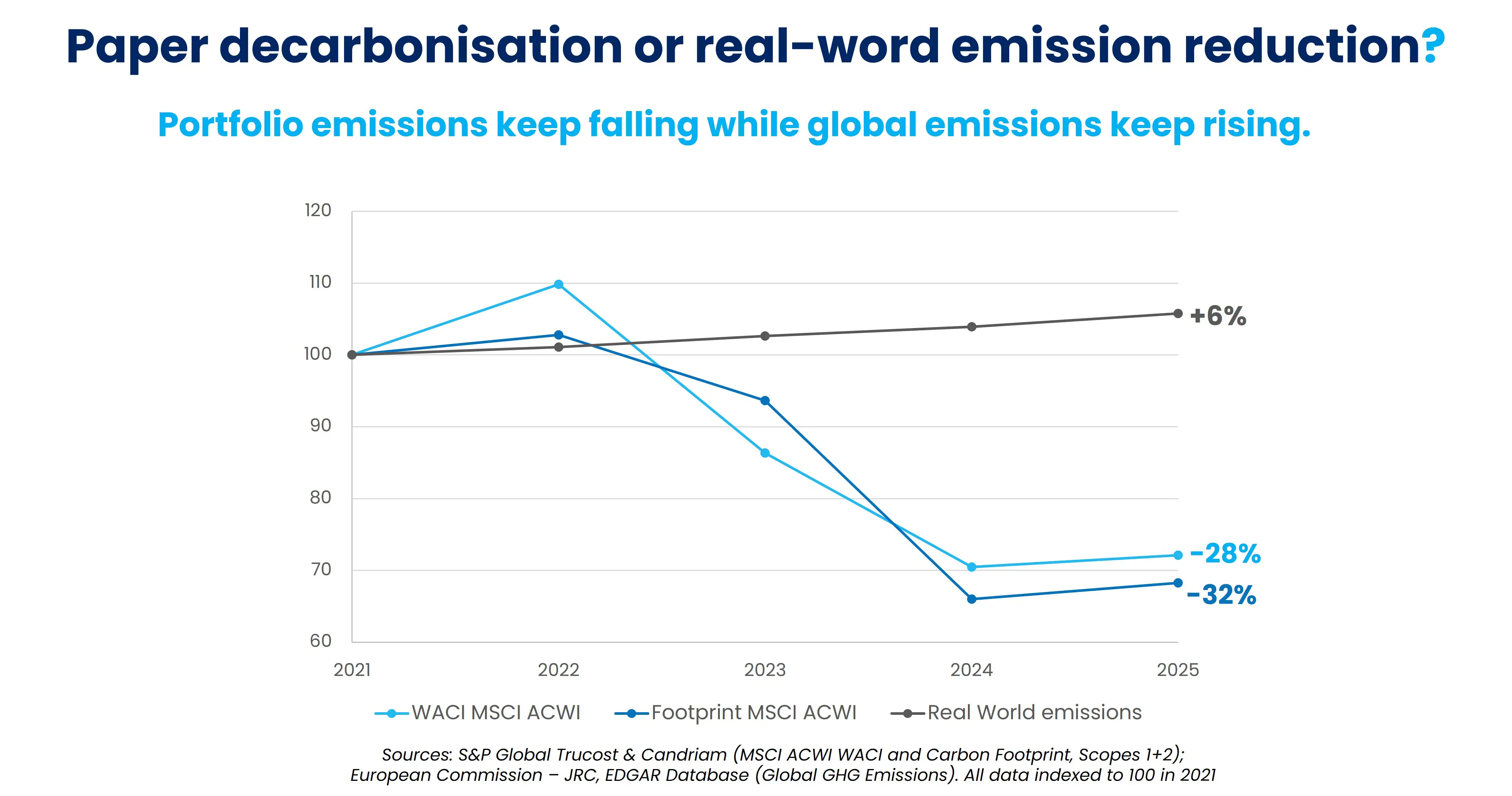
Judging by the carbon footprints of many investment portfolios, one might assume that the world is making rapid progress towards its climate objectives. Indeed, the MSCI ACWI recorded an average annual decline of around 8% in its carbon footprint over recent years[1] (see graph). Yet, global CO₂ emissions continue to rise, reaching a new record in 2025. How can these trends coexist? The paradox illustrates a central challenge for sustainable investors: improving portfolio carbon metrics does not necessarily mean reducing emissions in the real economy.

Key takeaways
-
Declining portfolio or index carbon footprints do not necessarily reflect equivalent emissions reductions in the real economy.
-
Assessing real-world decarbonisation requires looking beyond financial carbon metrics to examine physical emissions intensity, credible transition plans and capital expenditure.
-
Combining portfolio metrics and targets with fundamental transition analysis and outcome-oriented shareholder engagement is essential to building meaningful climate investment strategies.
When decarbonisation remains on paper
Portfolio carbon footprints have become central to climate investment strategies. They help investors assess the carbon exposure of their holdings, estimate climate risks, monitor portfolio objectives and compare their performance against benchmarks.
However, they do not always reflect actual emissions reductions or an investment strategy’s contribution to real-world decarbonisation.
One reason lies in how financial carbon metrics are calculated. Carbon footprints (CF) and weighted average carbon intensity (WACI) can decline as enterprise values or revenues increase, even where companies’ absolute emissions remain unchanged.


A falling carbon footprint, unchanged emissions
Consider an investor holding €1 million in a company emitting 100,000 tonnes of CO₂e annually, with an enterprise value including cash of €100 million. Its attributed carbon footprint is 1,000 tonnes of CO₂e per €1 million invested. If the company's enterprise value doubles while emissions and the investment amount remain unchanged, the reported footprint falls by half — even though no actual emissions reductions have occurred.
INITIAL POSITION
1,000
tCO₂e per €1m invested
AFTER EVIC DOUBLES
500
tCO₂e per €1m invested
Illustrative example holding the investment amount constant
Portfolio sector reallocation can produce a similar effect. Moving investments away from carbon-intensive industries towards lower-emitting sectors can improve portfolio-level carbon indicators without necessarily reducing emissions in the wider economy.
This phenomenon is sometimes described as “paper decarbonisation”: financial carbon metrics improve, while the underlying transformation of economic activities remains limited.
This does not make financial carbon metrics irrelevant. They remain useful portfolio management tools. But their evolution alone cannot, on their own, demonstrate genuine progress in real-world decarbonisation.
Looking at what companies actually produce
To assess real-world progress, investors need to complement financial carbon indicators with metrics that reflect changes in companies' underlying activities.
Physical emissions intensity provides one such measure: grams of CO₂ emitted per kilowatt-hour of electricity generated, kilograms of CO₂ per tonne of cementitious product or tonnes of CO₂ per tonne of steel produced.
Unlike financial carbon-intensity measures, these indicators are not directly affected by fluctuations in share prices or enterprise values. They can therefore provide a clearer picture of whether a company's production processes are becoming less carbon intensive.
However, declining physical intensity does not necessarily mean lower absolute emissions: increasing production volumes may offset efficiency improvements.
Investors therefore need to combine physical intensity and absolute emissions with sector-specific decarbonisation pathways, assessing not only companies’ current emissions but also their progress towards reducing them.

A credible transition is more than a 2050 target
A net zero commitment for 2050 is not sufficient evidence of a credible transition strategy. Investors must assess interim targets, the feasibility of proposed decarbonisation levers and the resources allocated to implementation, particularly in hard-to-abate sectors.
In capital-intensive industries, today’s capital expenditure determines tomorrow’s activity mix. Strategic planning and capital allocation are therefore essential indicators to assess the credibility of transition plans.
The carbon budget reinforces the importance of timing. Because CO₂ accumulates in the atmosphere, delaying emissions reductions consumes more of the remaining budget, requiring faster and deeper reductions later to meet climate objectives.
An energy company continuing to allocate most of its capital expenditure to new fossil fuel projects beyond 2030, for example, may struggle to demonstrate how these investments align with its stated net zero ambition for 2050.
The credibility of a transition strategy ultimately depends on whether operational decisions and capital allocation support stated climate objectives.
Connecting portfolio objectives with real-world change
What does this mean for investors seeking to build credible climate strategies?
Portfolio carbon metrics remain an important starting point, but they should be complemented by issuer-specific analysis of physical emissions intensity, absolute emissions, forward-looking transition trajectories and capital expenditure.
This more fundamental approach can help investors distinguish companies genuinely transforming their activities from those whose reported climate performance benefits primarily from financial or accounting effects.
Outcome-oriented shareholder engagement is equally important. By questioning transition assumptions, challenging insufficient interim targets and examining capital allocation, investors can encourage companies to strengthen their decarbonisation strategies.
This is key as climate investing is enlarging towards transition investment, aimed at financing the transition of sectors and companies whose transitions are less advanced.
Transition engagement should be supported by a clear theory of change explaining how investor influence can translate into real-world decarbonisation. If not, it would just be another excuse for climate inaction, and further widen the gap between investors’ climate objectives and global climate goals.
An important distinction remains: investing in companies that reduce their emissions does not automatically demonstrate that investors have caused those reductions. Establishing an investment strategy's contribution to real-world change requires additional evidence and appropriate measurement.
The challenge is therefore to connect portfolio-level climate objectives with measurable changes in the companies and economic activities being financed.
Grounding climate investments in the real economy
A declining portfolio carbon footprint may be an important investment objective, but it is not the ultimate measure of climate progress. Unfortunately, the focus on portfolio decarbonisation has sometimes translated in sector reallocations away from carbon-intensive sectors whose transformation is essential to the transition.
The main challenge for climate investors is to connect financial indicators with tangible changes in corporate activities, capital allocation and emissions trajectories.
Ultimately, the credibility of climate investing will depend not simply on improving portfolio metrics, but on investors’ ability to move the needle, not on paper, but on the ground.
Explore more Candriam insights
Explore Candriam's research on climate change, corporate transition strategies and sustainable investing to understand the challenges of aligning investment portfolios with real-world decarbonisation.

Dive deeper into the climate conversation
In our latest ESG Talks webinar, "Too hot to ignore: Investing in a warming world", Alix explores what investing in a warming world really means — and why every fraction of a degree matters.