
A Candriam and CAIA Association Webinar Series
Discover our “Navigating Private Markets Today: Investor Perspectives” webinar series, developed in collaboration with the CAIA Association.


By Jérémie Sternis, Candriam and Francesco Gonzaga, Andera Partners
For much of the past decade, private equity benefited from powerful tailwinds. Low borrowing costs made acquisitions cheaper to finance, while steadily rising valuations helped boost returns when investments were sold. In many cases, these conditions provided additional support to returns.
Today, that equation has changed. Higher financing costs, more demanding valuations and a selective exit environment mean that private equity managers can no longer rely on the same favourable conditions. Instead, returns must increasingly be earned through the performance of the businesses themselves.
This is not necessarily a negative development. Rather, it represents a return to some of the fundamentals of private equity: identifying promising companies, working closely with management teams and building stronger businesses over time.
For investors, this places greater emphasis on a manager’s ability to support business growth and deliver lasting operational improvements.
The scale of this shift is striking. Bain & Company’s analysis suggests that where approximately 5% annual EBITDA growth could previously support a 2.5x investment return over five years, today’s environment may require growth closer to 10–12% to achieve a comparable result.[1]
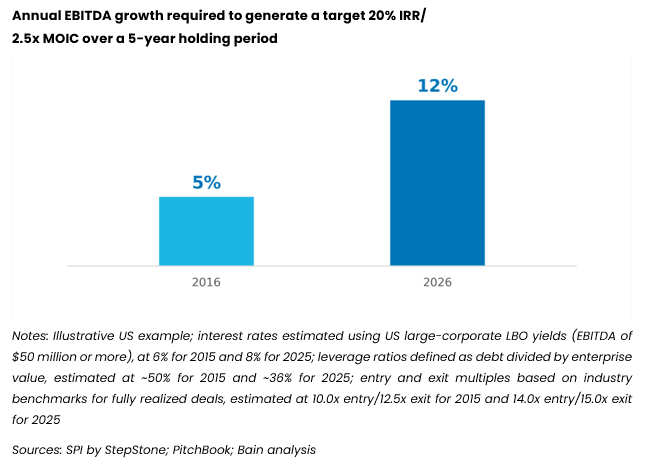
That is a higher bar. But it does not mean such returns are necessarily out of reach.
The key lies in combining several sources of value creation: organic revenue growth, improved profitability and carefully selected M&A that may strengthen a company’s competitive position and dilute entry multiple.
Importantly, valuation multiples still matter. But there is a distinction between benefiting from a general rise in market valuations and earning a higher valuation through genuine business transformation.
A company that has become larger, more diversified, better managed and more international may command a higher multiple because it represents a fundamentally different proposition to potential buyers.
This distinction should also influence investment discipline. At Andera MidCap, for example, the approach has consistently been to underwrite investments assuming a stable exit multiple, treating any subsequent expansion as potential upside rather than a prerequisite for achieving the investment case. Similarly, acquisitions should accelerate an already credible organic growth strategy, not compensate for the absence of one.
If operational improvement is becoming more important, where can private equity managers find opportunities to deliver it? We believe Europe’s lower mid-market offers particularly interesting opportunities.
Europe’s corporate landscape contains a substantial population of founder-led and family-owned businesses. Many have developed strong customer relationships, specialist expertise and established reputations within their markets. Their entrepreneurial agility is often an important source of competitive advantage.
Yet these strengths can coexist with significant untapped potential. A successful family business may lack the management depth needed to expand internationally. Its reporting systems may be underdeveloped, or its commercial operations may rely heavily on a handful of individuals. Strategic acquisitions might offer compelling opportunities, but the company may not have the resources or expertise to pursue them.
For private equity investors, these are opportunities to help fundamentally sound businesses reach their next stage of development.
Turning potential into performance requires more than an ambitious business plan. It demands practical execution, often beginning before an investment has even been completed.
Three areas are particularly important:
An ongoing investment within Andera MidCap portfolio illustrates how these elements can work together. The business, a family-owned producer of specialty cables, harnesses and connectivity solutions, generated approximately €130 million[2] in annual revenue when Andera invested. It had strong industrial capabilities and customer relationships, but a relatively lean management structure and limited international reach.
Working with the management team, Andera MidCap is carrying out a transformation plan supported by a group CEO, focused on strengthening financial and operational functions, and expanding the commercial team.
Alongside these initiatives, the company completed two strategic acquisitions, including one in the United States, providing access to a much larger market and broadening its international presence.
Within two years, revenue had increased to approximately €175 million[3], supported by both organic initiatives and acquisitions. The business also emerged with a stronger management team, more developed processes and systems and a more diversified commercial footprint.
The transformation remains ongoing, and its ultimate investment outcome is yet to be determined. Nevertheless, it demonstrates how active ownership can help a successful entrepreneurial business develop capabilities that would have been difficult to build independently.
Of course, creating value is only part of the equation. Private equity managers must ultimately realise that value and return capital to investors.
Today’s exit market remains selective. Businesses demonstrating resilient earnings, visible growth and credible opportunities for further development are more likely to attract buyer interest.
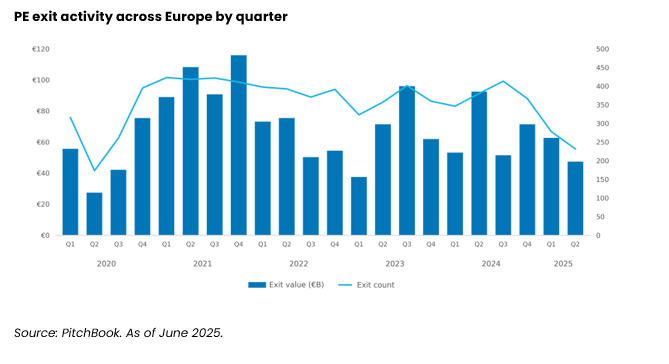
Here, the European lower mid-market can offer advantages. Growing companies may attract both strategic acquirers and larger private equity funds with significant dry powder to deploy seeking established platforms for their own expansion strategies.
Crucially, the right moment to sell is not necessarily when every possible improvement has been made. It may be when the business is ready for its next phase of growth, and a new owner is best positioned to deliver it.
Successful exits therefore depend not only on the value created during ownership, but also on demonstrating the opportunities that remain.
Private equity’s fundamental proposition has not changed: identify quality companies, partner with ambitious management teams and help businesses realise their potential.
What has changed is the environment in which that proposition must be delivered.
Without the same financial tailwinds, the ability to execute credible transformation strategies, improve operational performance and build businesses that future owners want to acquire is becoming an increasingly important differentiator.
In that sense, private equity’s return to fundamentals is also an opportunity to demonstrate what active ownership can truly achieve.
[1] Source: Bain & Company, Global Private Equity Report 2026
[2] Source: Andera Partners, 30 October 2026
[3] Source: Andera Partners, 30 October 2026
A changing return equation: the drivers of private equity returns are increasingly focused on operational performance and sustainable growth.
Quality businesses, untapped potential: Europe’s lower mid-market offers opportunities to unlock value through professionalisation, international expansion and strategic acquisitions.
From investment to exit: In a selective market, disciplined value creation and tangible operational improvements, combined with a disciplined exit strategy, are increasingly important.


Get information faster with a single click