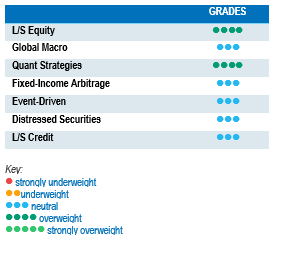
The global economy experienced a mild slowdown due to a lower contribution of services to the World PMI and lower consumer participation. Inflation continued to recede in the US although at a slower pace. However, the market’s direction has turned during the month due to the rising levels of uncertainty caused by the unpredictability of the US Administration and the impact of tariff policies on the health of the economy.
Equity markets’ performance was dispersed during the month. US equities lagged, driven by multiple compression of growth stocks. During the period, European and Chinese equities outperformed, drawing investors with their lower valuations and substantial investment programmes in defence and technology. At a sector level, investors favoured European equities, with financials, telecom and industrials outperforming. At the other end, US consumer discretionary, telecom and industrials were a drag on returns.
US Treasuries with maturities over 5 years have tightened by around 30 basis points with investors moving to safe assets. Gold prices also continued to grind higher. IG and HY corporate spreads started to widen after mid-month but remained relatively isolated from troubles brewing in the equity world.
The HFRX Global Hedge Fund EUR returned +0.16% over the month.
Long-Short Equity
Average performances were slightly positive during the period but very dispersed depending on the strategy’s style and region. Long-Short Equity strategies with a growth tilt lagged due to the underperformance of their long positions versus shorts. This was particularly the case for managers specialised or with significant technology and consumer books. Value style and defensive-focused strategies have outperformed as managers benefited from both positive alpha and market tailwind. Crowded names and thematics pulled back during the second part of the month as stretched stock price multiples are harder to justify in this context of higher economic uncertainty. Momentum reversals have been tricky periods for investors where performance destruction over the last few years has been magnified by deleveraging events of very large investment platforms. However, well diversified capital allocations to Long-Short Equity strategies have proved to be resilient during market drawdowns and able to generate strong risk-adjusted returns over time. In a world of sustained uncertainty and diverging economic performance, Long-Short Equities are able to extract alpha from increasing market dispersion.
Global Macro
On average, Global Macro strategies generated slightly positive returns during the period but were also fairly dispersed. Directional strategies with significant exposure to the Artificial Intelligence theme struggled. Long equity trades in technology stocks experienced multiple compression and investments related to electricity production were also detractors. As an example of the later, investors holding uranium futures saw prices drop, due to expectations of an end to the war and some contracts for data centres being cancelled by hyperscalers. Navigating higher volatility levels, partially driven by the hyperactivity of the new Trump Administration, is causing some challenges to global macro managers. At the same time, it is an important source of opportunities. The economic decoupling of major economical regional powerhouses has accelerated since the start of the year, offering interesting investment opportunities for macro managers.
Quant Strategies
In February, Multi-Strategy Quantitative strategies averaged positive low single-digit returns, outperforming CTA with positive contributions relatively evenly spread across asset classes and strategies. Trend followers had a more challenging period printing negative returns over the month. Gains generated in equities were negatively balanced by positions in currencies and commodities. Performances from fixed-income trades were muted due to mixed bag contributions.
Fixed-Income Arbitrage
After months of uncertainty surrounding inflation persistence and economic strength, central banks have adopted a more dovish stance, acknowledging the need for rate cuts as inflation normalises downward. Since the beginning of the year, economic data has pointed to growing uncertainty regarding inflation and economic growth across developed markets, with significant regional divergences. In the US, mixed macroeconomic data, combined with the potential impacts of Trump’s measures, have halted the steepening of the yield curve. In Europe and the UK, the 2-10 year spreads have remained unchanged, highlighting how market dynamics are increasingly uncorrelated across regions. In Japan, the end of ultra-loose monetary policy presents both relative value (RV) and directional opportunities. This environment has been highly supportive for the fixed-income space, both in terms of relative value and directional strategies.
Risk Arbitrage – Event-Driven
Event-Driven strategies did well during the month. Average performances were close to +1% with low levels of dispersion. Both merger arbitrage and special situations contributed positively to performance. Among the deals that added to performance are the counter-bid at a higher premium by Herc for H&E Equipment and the approval by the FTC of the Hashicorp/IBM deal. Donald Trump’s election has raised expectations of a deal bonanza during 2025 enabled by a more business-friendly approach by the regulator, falling cost of debt and significant amounts of dry powder held by private sponsors. According to industry specialists, the volume of deals was encouraging in January but fell significantly below expectations during February.
Distressed
Since the start of the year, equity markets pick up in volatility has not yet passed on to credit markets. Although they started to pick up at the end of February, they remain close to their historical tights. Managers are aware of current economic headwinds but they remain relatively constructive regarding the credit market. Currently, distressed specialists remain focused on idiosyncratic opportunities but are watching closely for market cracks. One of those weak spots seems to be the leverage loan market. Over the last 12 months, the number of US High Yield Bond issuers being upgraded is 20% higher than those being downgraded. For US loan issuers, upgrades are 40% lower than downgrades. Also, according to the JP Morgan Default Monitor, over the last 12 months, the percentage of loan defaults including liability management exercises has reached 3.9% which treble the level of high yield defaults of the same period.
Long-Short credit
Base interest rates remain wide, offering to investors in credit decent yields. However, corporate spreads are close to all-time lows. One wonders if investors are being appropriately remunerated for the risk taken. Managers have concentrated their portfolio into their highest fundamental convictions, increased the level of hedges and lowered strategy directionality. On the other side, such a rich market generates numerous opportunities for alpha shorts. Although rates are initiating a cut cycle, they remain at high levels which favours alpha generation both on long and short positions as fundamental research becomes more important in portfolio construction. Absolute return or hedged investment approaches have gained more relevance with the increase of idiosyncratic risks and geopolitical uncertainty. Risk diversification is important and should be an integral part of the investment allocation process.


