Why oncology may lead the next innovation cycle
A decade ago, the idea of detecting cancer from a blood sample, mapping a tumour's genetic profile, or designing a personalised therapy with the help of artificial intelligence sounded futuristic. Today, these advances are moving into clinical practice. For investors, that shift matters: healthcare is no longer only a defensive sector. It is also one of the most important innovation platforms of the next decade.
Healthcare stands at the intersection of structural demand, scientific innovation and favourable valuations. An ageing global population and improving access to care continue to support long-term growth, while breakthroughs in areas such as genomics, artificial intelligence and precision medicine are reshaping what modern healthcare can achieve. After several challenging years for the sector, this innovation cycle is now unfolding against a valuation backdrop that appears more compelling than it has for much of the past decade.
The sector also benefits from financial firepower, with large pharmaceutical companies' deal capacity exceeding $1.5 trillion[1], creating potential support for innovation-led companies through partnerships and acquisitions. Healthcare demand is also less sensitive to economic cycles than many other areas of the market as people need diagnosis and treatment in almost any environment.
Why invest in oncology
Within healthcare, oncology remains one of the biggest and most active therapeutic segments.
Cancer is one of the defining medical challenges of our time. In the US, around 38% of people are expected to receive a cancer diagnosis during their lifetime[2], and cancer remains among the leading causes of death globally. At the same time, oncology attracts a disproportionate share of scientific talent, clinical research and industry investment.
Progress is visible. Five-year cancer survival rates have improved significantly since the 1970s, helped by earlier detection, better screening and more targeted treatments. In 2025 alone, the US Food and Drug Administration (USFDA) approved 19 new cancer drugs, 16 new diagnostic tests and expanded uses for existing cancer therapies[3]. Each approval can expand the treatment landscape. For investors, regulatory progress can also help identify companies with differentiated science, stronger pipelines and clearer long-term growth potential. Every year from the strategy’s inception in 2019 through to the end of 2025, our oncology strategy has held exposure to companies behind approximately six out of ten newly approved cancer drugs globally,[4] illustrating both the breadth of today's innovation cycle and Candriam's long-standing focus on clinically differentiated companies.
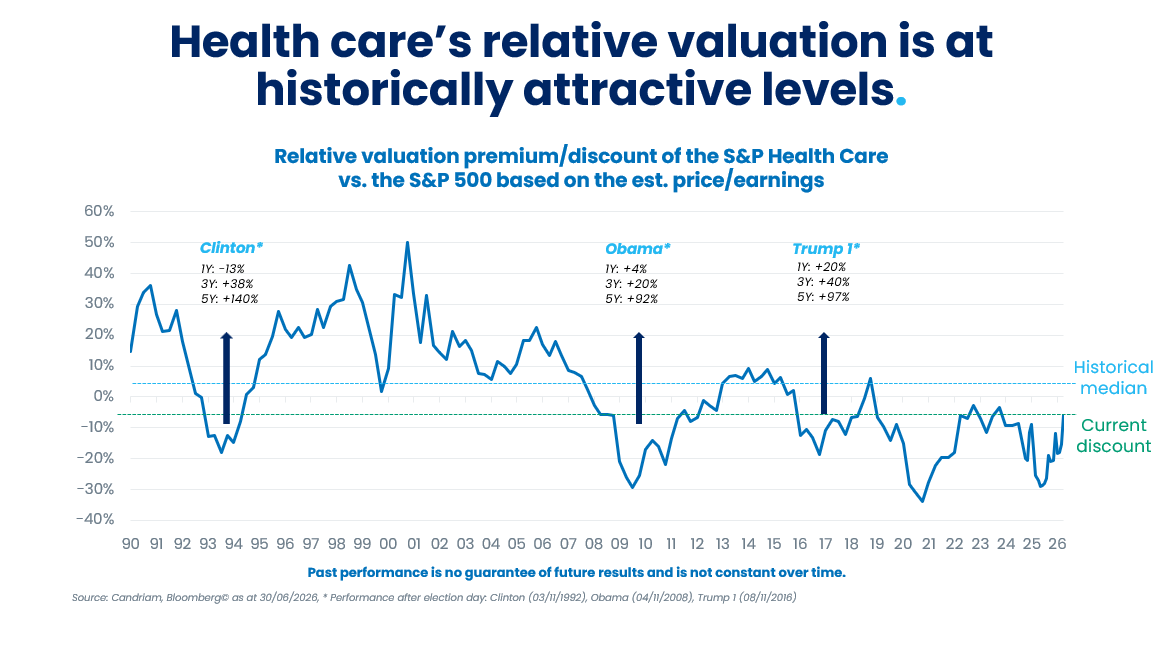
In addition, healthcare has also recently traded at a sizeable discount to the broader US equity market, a level seen only a few times over the past three decades. Historically, similar periods of discount have preceded stronger relative returns:
We believe that investing successfully in healthcare requires unique, combined expertise. That is why we bring together healthcare investors and scientific specialists, including professionals with PHDs in biology, biotechnology and oncology. This combined knowledge helps us assess both the financial profile of companies and the clinical relevance of their innovations.
Precision oncology is driving a paradigm shift in cancer care
The most important shift in oncology is the move from broad treatment to precision intervention. Instead of treating cancer only by location - lung, breast, colon – oncological innovation is increasingly targeting the pathological drivers of disease. Several novel trends are reshaping the field:
- Selective molecular diagnostics: liquid biopsies to measure circulating tumour DNA can help detect microscopic cancer outgrowth earlier than conventional imaging in some settings.
- Targeted therapies: treatments are increasingly designed around specific molecular traits present in cancer tissues and highly captured with sophisticated biomarker strategies.
- Immunotherapy and cell therapy: the re-wiring the patient immune system is becoming a central tool in fighting cancer.
- Radiopharmaceuticals: targeted radiotherapeutics may open new treatment pathways for selected cancers.
- AI-enabled discovery and trial design: data can help identify patient groups, accelerate pharmacological and clinical research and improve the probability of clinical success.[5]
These advances are also changing the economics of oncology. The US precision oncology market was estimated at around USD 40 billion in 2025[6] and is projected to grow strongly over the next decade. Growth will not be linear. Clinical trial failures, pricing pressure, reimbursement decisions and regulatory outcomes can create sharp dispersion between winners and losers. That is why selectivity matters.
Fighting cancer earlier is the next frontier
For decades, oncology innovation focused primarily on treating cancer once it had been diagnosed. Today, the front line has shifted to earlier intervention. Advances in genomic sequencing, liquid biopsy and molecular diagnostics are making it possible to detect signs of disease at increasingly early stages, in some cases before symptoms appear or before cancer becomes visible through conventional imaging.
This shift has the potential to transform outcomes. Earlier detection can help clinicians intervene sooner, when treatment options may be more. At the same time, new diagnostic technologies are generating valuable insights that can guide more personalised treatment decisions and improve patient monitoring over time.
As a result, the oncology opportunity is expanding beyond therapeutics alone. Companies involved in diagnostics, screening technologies, precision testing and data-driven healthcare are becoming an increasingly important part of the innovation ecosystem. For investors, this broadens the opportunity set and highlights how the future of oncology may be shaped not only by better treatments, but also by the ability to prevent, detect and manage disease more effectively.
Discover the Candriam Equities L Oncology fund
Related news
-
Europe strengthens healthcare sovereignty through supply chain resilience, policy reform and innovation, creating new investment opportunities. -
Biotechnology in 2026: innovation with selectivity
After a stronger 2025, biotechnology entered 2026 on firm footing. Innovation remains robust, valuations are still supportive and investor interest is improving. In a selective market, Candriam focuses on differentiated assets, commercial potential and disciplined portfolio construction. -
Why healthcare, why now?
On Tuesday, September 30, the pharmaceutical industry issued its first formal response to President Trump’s recent letter on drug pricing, announcing a deal between Pfizer and the US administration. -
From uncertainty to growth: why invest in healthcare?
As we enter the month of October, investors are faced with an obvious question: is the time right for new investments in the oncology sector? Pasquale Sansone, Senior Biotechnology Analyst, shares his analysis and convictions. -
Why oncology remains a key investment opportunity
The investment landscape is marked by persistent macroeconomic uncertainties, uneven growth, and heightened geopolitical risks. Despite attractive earnings growth, healthcare has also been under pressure due to regulatory restructuring, drug pricing debates, budget constraints, and tariff concerns. -
Pharma tariffs: a complex puzzle
On Sunday, July 27, 2025, the EU and the US successfully concluded a trade agreement, paving the way for strengthened economic relations between the two regions. While initial reports caused some confusion, it now appears that most pharmaceutical products, excluding certain generics, will be subject to a 15% tariff. -
Biotech : 25 years of innovation in the service of healthcare
Over the past twenty-five years, the medical biotechnology sector has profoundly transformed the therapeutic landscape. From the fight against cancer to the development of Covid-19 vaccines in record time, advances in biopharma have changed the outcome for millions of patients worldwide. -
Time to Re-engage with Healthcare?
Healthcare share prices tend to reflect some trepidation leading up to and shortly after the US presidential elections, yet for the last five elections the sector outperformed in the 12 months following the election.