Mensaje importante: Cuidado con las estafas de suplantación de identidad

Actualmente circulan mensajes y anuncios fraudulentos en plataformas de mensajería, incluido WhatsApp, que suplantan la marca Candriam y a profesionales de la inversión. Tenga en cuenta que Candriam nunca ofrece recomendaciones de inversión ni proporciona asesoramiento financiero a través de canales de redes sociales o plataformas de mensajería.

A Practical Framework for Fixed Income Investors

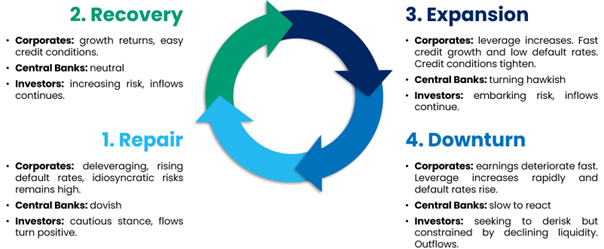
If you ask a fixed income investor to describe the credit cycle, most will readily cite its four familiar phases: Repair, Recovery, Expansion and Downturn. Knowing the terminology is straightforward. The more relevant question is: why does it matter for portfolio outcomes?

Credit cycles are a primary driver of returns in fixed income. Yet they are often misdiagnosed, oversimplified, or identified only in hindsight. While precise timing is inherently uncertain, transitions between phases tend to exhibit recurring patterns in credit spreads, issuance dynamics, leverage trends, and liquidity conditions.

Charudatta Shende;
Charudatta Shende
Head of Client Portfolio Management Fixed Income and Fixed Income Strategist
In credit investing, the best time to manage risk is precisely when it feels unnecessary because markets appear comfortable.

The Credit Cycle at a Glance


Why the Cycle Matters for Portfolio Management

More than labels, what matters is the evolving nature of risk embedded within each phase. Behind each stage lie shifting refinancing conditions and liquidity dynamics—factors that directly influence spread compensation, default risk, and dispersion across issuers and sectors. Our research paper moves beyond theory. It presents a disciplined framework for understanding the credit cycle and how to position portfolios accordingly.

Discover the main take-aways of the paper in this short video  

Doma el riesgo.

No huyas de él. 

La deuda corporativa puede parecer una inversión tranquila, porque las rentabilidades son constantes la mayor parte del tiempo. Pero es una clase de activos asimétrica: la subida se limita al cupón, mientras que la caída puede ser permanente si los fundamentales se debilitan o la liquidez desaparece.

Saber más

Buscador rápido

Obtenga información más rápidamente con un solo clic

Reciba información directamente en su bandeja de entrada