;
A Practical Framework for Fixed Income Investors
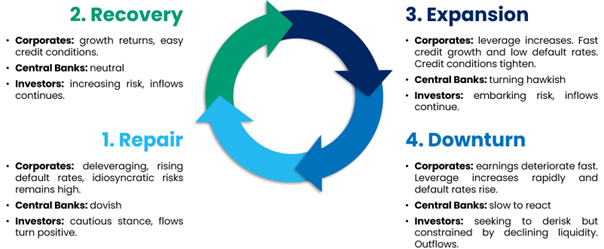
If you ask a fixed income investor to describe the credit cycle, most will readily cite its four familiar phases: Repair, Recovery, Expansion and Downturn. Knowing the terminology is straightforward. The more relevant question is: why does it matter for portfolio outcomes?
Credit cycles are a primary driver of returns in fixed income. Yet they are often misdiagnosed, oversimplified, or identified only in hindsight. While precise timing is inherently uncertain, transitions between phases tend to exhibit recurring patterns in credit spreads, issuance dynamics, leverage trends, and liquidity conditions.
;
”In credit investing, the best time to manage risk is precisely when it feels unnecessary because markets appear comfortable.
The Credit Cycle at a Glance

Why the Cycle Matters for Portfolio Management
More than labels, what matters is the evolving nature of risk embedded within each phase. Behind each stage lie shifting refinancing conditions and liquidity dynamics—factors that directly influence spread compensation, default risk, and dispersion across issuers and sectors. Our research paper moves beyond theory. It presents a disciplined framework for understanding the credit cycle and how to position portfolios accordingly.
Discover the main take-aways of the paper in this short video
Tame Risks.
Don't run from it.
Bedrijfsobligaties kunnen rustig aanvoelen omdat het rendement meestal stabiel is. Maar bedrijfsobligaties zijn asymmetrisch: het opwaarts potentieel is beperkt tot de coupon, terwijl het neerwaarts potentieel permanent kan zijn als de fundamentals verzwakken of de liquiditeit verdwijnt.