


Dans un paysage en constante évolution, marqué par des tensions géopolitiques, l’importance croissante des enjeux liés au changement climatique et une réorientation de l'économie mondiale, une tendance de fond se dessine. La croissance se déplace progressivement vers les pays en développement en dehors de la Chine, un déplacement intensifié par les avantages démographiques et l'évolution de la structure de l’économie mondiale. Alors que les dissensions géopolitiques favorisent la sous-traitance de proximité, certains pays en développement sont confrontés à des défis liés à leur démographie - autrefois avantageuse, celle-ci présente aujourd'hui des risques en raison du vieillissement de la population. L'impact de la transformation liée au changement climatique et à l'automatisation induite par l'IA ne fait qu’ajouter à la complexité de l'équation économique mondiale.
Les cartes du commerce mondial sont rebattues
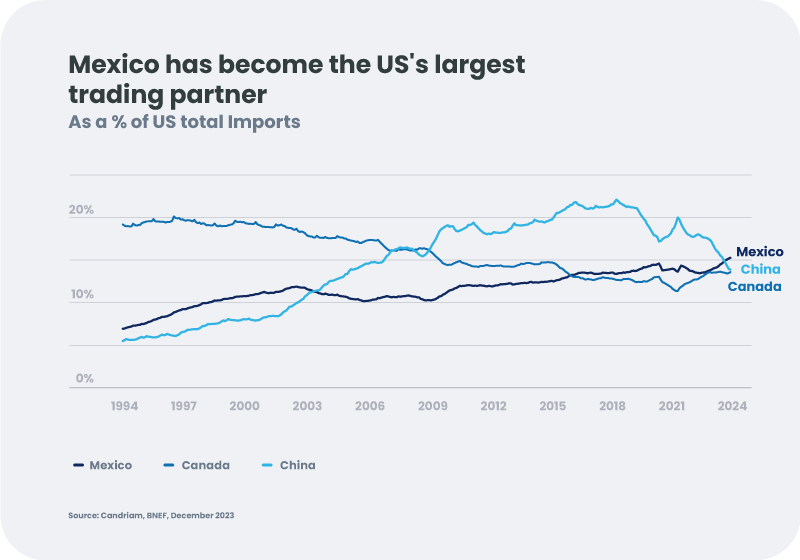
Les années 90 ont vu l'essor de la révolution technologique moderne, qui a conduit à l'externalisation et à la délocalisation de la production vers des pays bénéficiant d’une main-d'œuvre moins chère et de normes environnementales plus souples. Le remaniement des chaînes d'approvisionnement et les stratégies « Chine plus un » créent des opportunités pour de nombreux autres pays en développement, en particulier le Mexique, l’Inde et l’Asie du Sud-Est, où les entreprises internationales ont commencé à investir dans des chaînes d'approvisionnement alternatives.
Le Mexique est l’un des premiers bénéficiaires de cette situation, en raison de sa proximité géographique avec les États-Unis, dont il est déjà devenu le premier partenaire commercial. En Asie, les efforts de diversification de la chaîne d'approvisionnement sont générateurs de croissance pour les entreprises manufacturières et exportatrices notamment indiennes, dans des secteurs tels que la pharmacie, la biotechnologie et la fabrication de produits électroniques.
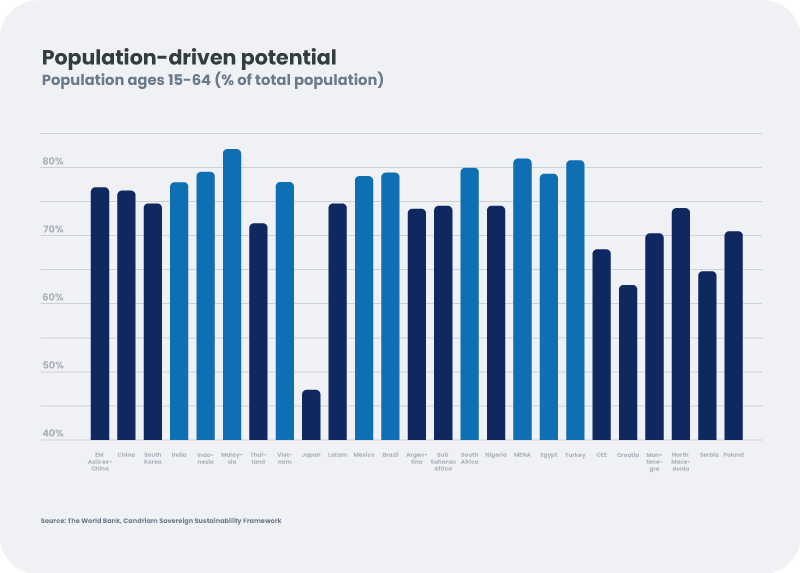
Lorsque l'on examine le potentiel de chaque pays à bénéficier de la nouvelle économie mondiale décarbonée, il faut tenir compte de sa dynamique démographique et de sa capacité à prendre une part active à la transformation et à exploiter de nouvelles sources de demande au niveau national et plus localement.
Les dividendes démographiques donnent l’avantage aux nouveaux leaders des marchés émergents
Pendant de nombreuses années, la Chine a bénéficié d'un pourcentage substantiel de personnes en âge de travailler dans sa population ; cependant, le pays traverse actuellement un profond changement démographique lié au vieillissement de la population. Pour éclairer notre point de vue, il faut prendre en compte différents facteurs qui influencent la dynamique de croissance de la demande. Notre modèle de durabilité sur les émetteurs souverains fournit des informations supplémentaires sur les perspectives de croissance de chaque région et de chaque pays. Il faut ajuster les données sur la population en âge de travailler pour tenir compte des conditions du marché du travail, y compris la répartition par sexe, la participation de la population active, les profils des secteurs et les conditions de travail. En outre, les systèmes de santé ont une influence importante pour les populations qui ne sont plus en âge de travailler, et les très jeunes. Lors de l'évaluation du potentiel de chaque pays, la proportion de jeunes dans chaque pays devrait également tenir compte de la qualité et de la disponibilité de l'éducation. Des pays tels que l'Inde, l'Indonésie et la Malaisie sont en voie d'améliorer leur performance sur la base de cet indicateur.
De nouvelles alliances dans le domaine de la transition énergétique ouvrent des perspectives de croissance pour les marchés émergents en dehors de la Chine
Le monde est en pleine transition vers de nouvelles technologies qui favorisent l'électrification de l'économie mondiale, avec un accent particulier sur les technologies liées aux batteries et aux semi-conducteurs. Les minerais critiques comme le lithium, le nickel, le cobalt, le graphite et le manganèse, essentiels à la production des batteries des véhicules électriques, doivent faire face des chaînes d'approvisionnement concentrées, dominées principalement par l'Australie et la Chine. Les considérations politiques et géopolitiques des États-Unis et de l'UE visent à réduire leur dépendance à l'égard des chaînes d'approvisionnement étrangères.
En termes d'extraction des minerais, une certaine diversification est envisageable, notamment pour le graphite dont l'Europe et le Brésil détiennent d'importantes réserves. Il faut pour cela des études géologiques de meilleure qualité dans les marchés émergents, ainsi que des progrès dans les technologies de recyclage. Actuellement, la Chine domine la production de cellules de batteries, mais la Corée et le Japon jouent un rôle essentiel en aval. Grâce à des politiques de soutien et à des évolutions géopolitiques, d'autres pays en développement devraient potentiellement rattraper leur retard.
La transition énergétique de l'UE et des États-Unis va dans le sens de partenariats avec des pays en dehors de la Chine, ce qui crée des opportunités de croissance pour d'autres pays en développement. Des lois telles que la loi européenne sur les matériaux critiques[1] et la loi américaine sur la réduction de l'inflation (IRA)[2] jettent les bases pour de nouvelles opportunités liées à la transition énergétique dans des pays comme la Corée[3], l'Indonésie et l'Amérique latine.
Les marchés émergents hors Chine qui sont au cœur de la chaîne de valeur des technologies de l'IA
La chaîne d'approvisionnement mondiale en semi-conducteurs est dominée par Taïwan et la Corée du Sud, régions fortement représentées dans les marchés émergents hors Chine. Un examen plus approfondi de la riche chaîne de valeur de l'IA dans les pays en développement révèle leur rôle central dans l'infrastructure essentielle à la ruée mondiale vers l'IA, depuis les points névralgiques que sont la fabrication de semi-conducteurs et de matériel hardware en Asie, jusqu'à l'émergence de technologies innovantes telles que la mémoire à haute bande passante et les procédés de fabrication CoWoS pour circuits intégrés. Ces régions apparaissent dès lors comme des moteurs essentiels du développement des structures et des technologies de la chaîne d'approvisionnement de l'IA, et nous semblent offrir un potentiel de croissance significatif dans les années à venir.
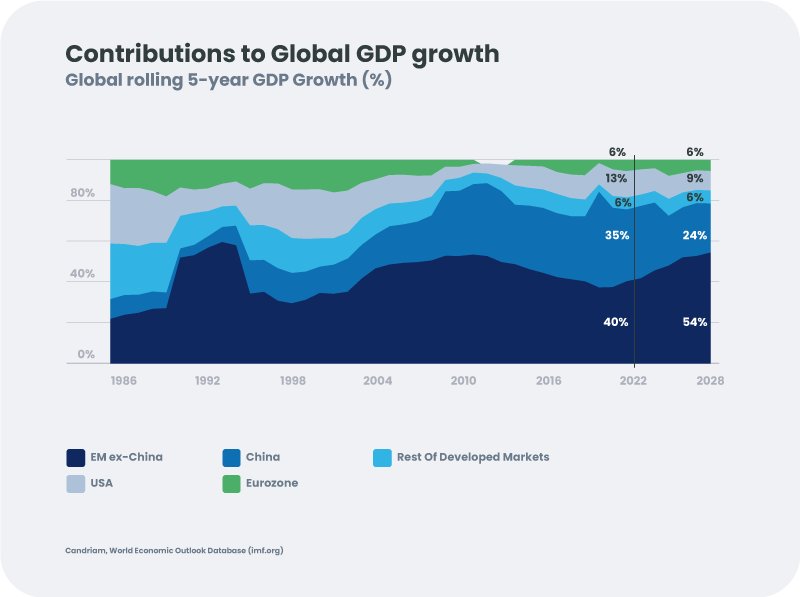
En conclusion, les opportunités d'investissement dans les marchés émergents vont bien au-delà de la Chine, et se trouvent à un moment charnière. Une dynamique démographique favorable, des évolutions géopolitiques positives et des opportunités dans le domaine de la transition énergétique et des chaînes d'approvisionnement en semi-conducteurs pourraient permettre à ces marchés de tirer durablement la croissance mondiale. Il n'est pas surprenant que les marchés émergents hors Chine, soient considérés comme le principal moteur de la croissance mondiale dans les années à venir. L'exécution et la concrétisation de ces opportunités de croissance détermineront leur rôle en tant que contributeurs à l'expansion économique mondiale. Alors que le monde se tourne vers eux, ces marchés doivent se montrer à la hauteur de la situation, en s'engageant sur la voie d'une croissance durable et robuste dans un paysage économique mondial en constante évolution.
Ce document est fourni à titre d’information et à des fins éducatives uniquement et peut contenir des opinions de Candriam et des informations propriétaires. Il ne constitue pas une offre d’achat ou de vente d’instruments financiers, ni un conseil en investissement et ne confirme aucune transaction, sauf convention contraire expresse. Bien que Candriam sélectionne soigneusement les données et sources utilisées, des erreurs ou omissions ne peuvent pas être exclues a priori. Candriam ne peut être tenue responsable de dommages directs ou indirects résultant de l'utilisation de ce document. Les droits de propriété intellectuelle de Candriam doivent être respectés à tout moment; le contenu de ce document ne peut être reproduit sans accord écrit préalable.
[1] Loi européenne sur les matières premières critiques (europa.eu)
[2] La loi sur la réduction de l'inflation et le programme CHIPS alimentent le boom de la construction avec Intel, TSM et Samsung comme principaux acteurs Investor's Business Daily (investors.com)
[3] Partenariat vert entre l'UE et la République de Corée (europa.eu)
-

Octobre rose 2026 et l’évolution vers un traitement plus précis du cancer
Un diagnostic de cancer soulève des questions très personnelles. Quel traitement est le plus susceptible de fonctionner ? Comment les médecins sauront-ils si cela a fonctionné ? -

L’Europe peut-elle se frayer un chemin vers l’autonomie énergétique ?
L’Europe est peut-être en train de mettre fin à sa dépendance vis-à-vis des énergies fossiles russes, mais l’autonomie énergétique ne sera pas atteinte uniquement en modifiant le mix énergétique. Elle nécessitera de disposer de réseaux plus solides, d’une capacité industrielle accrue et de chaînes d’approvisionnement en matières premières essentielles plus résilientes. -

La dispersion et les tendances créent des opportunités
September was characterised by resilient global economic activity, persistent inflationary pressures and increasing concerns over monetary tightening and geopolitical risks. In the United States, economic momentum remained robust, supported by AI-related investment and resilient consumption, despite signs of labour market moderation. In Europe, economic indicators continued to improve, with manufacturing and services PMIs signalling greater resilience. -

Le test des bénéfices
Après une période où les bénéfices ont permis aux actions d’absorber la hausse des taux, la hausse des rendements commence à peser sur le sentiment des investisseurs en actions. La saison des résultats du troisième trimestre permettra de savoir si les entreprises peuvent conserver la confiance du marché grâce à des résultats solides et des prévisions crédibles. Les projections de bénéfices continuent d’augmenter, une tendance encourageante qui accroit cependant la pression sur les entreprises. -

Les bénéfices au centre de l’attention
La Fed a relevé ses taux alors que les investisseurs il y a quelques mois à peine anticipaient des baisses. Les marchés tablent désormais sur une poursuite du resserrement monétaire jusqu’en 2027, mais les actions américaines restent en hausse depuis le début de l’année. Les prévisions de bénéfices ont résisté au retournement des anticipations de politique monétaire. La saison des résultats du troisième trimestre permettra de vérifier si les entreprises sont en mesure de répondre à ces attentes. -

Maintien d’une surpondération de la duration sur les taux européens
Nous surpondérons légèrement la duration du segment 2-5 ans après la forte correction de septembre. La hausse des rendements réels a rendu les valorisations plus intéressantes, mais notre conviction reste limitée. Elle s’appuie essentiellement sur la politique monétaire : les marchés anticipent un taux directeur autour de 4,75 % , ce qui laisse espérer un cycle de resserrement moins agressif. -

Envolée de la dette liée à l’IA
L’essor des infrastructures liées à l’IA pousse certaines des plus grandes entreprises technologiques mondiales à faire davantage appel aux marchés de la dette. -

Identifier le risque climatique dans le crédit
Lorsque les indices climatiques ne sont pas d’accord, l’écart est-il simplement un bruit, ou un risque que les marchés du crédit évaluent ? Cet article établit un lien entre la recherche académique et les pratiques d’investissement afin d’explorer l’incertitude liée au bêta climatique des obligations d’entreprise américaines et européennes.