Skip to main content Skip to header search Skip to header search

Important Message: Beware of Impersonation Scams

Fraudulent messages and advertisements are currently circulating on messaging platforms, including WhatsApp, impersonating Candriam’s brand and investment professionals. Please note that Candriam never offers investment recommendations or provides financial advice through social media channels or messaging platforms.

Credit’s Circular Conundrum

A summer that refused to break

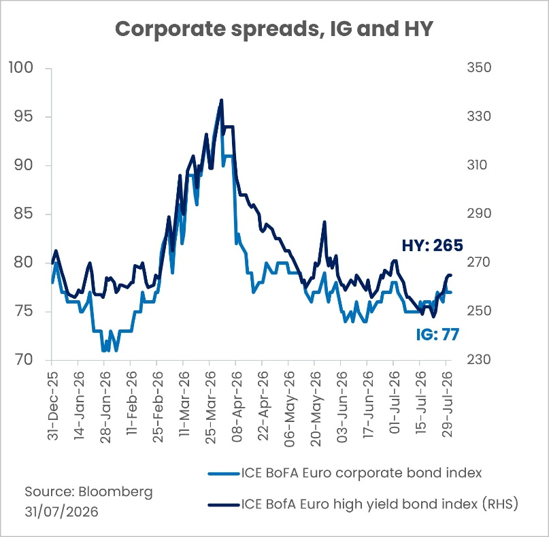
Credit markets have spent the summer displaying an almost improbable degree of composure. Renewed tensions around the Strait of Hormuz, disruption to tanker traffic and sharp swings in oil prices repeatedly unsettled rates markets, while the continuing war in Ukraine has ensured that geopolitical risk never receded far from view. Yet Euro investment-grade spreads remained confined to a remarkably narrow corridor of roughly 74 to 78 basis points[1], while Euro high yield oscillated between approximately 250 and 270 basis points[2]. The calm was not the absence of shocks but rather the market’s refusal to reprice them.

  • Charudatta Shende - Head of Client Portfolio Management Fixed Income and Fixed Income Strategist | Candriam
    Charudatta Shende
    Head of Client Portfolio Management Fixed Income and Fixed Income Strategist


Despite these tensions, there were sound reasons for this resilience. Corporate fundamentals remained broadly robust, particularly in the investment grade segment, where earnings, liquidity and leverage compared favourably with the increasingly fragile fiscal position of many sovereign issuers. The US economy remained sufficiently resilient to support revenues and margins. The high yield segment was less uniformly strong, but its default picture remained manageable. Moody’s counted fewer corporate defaults in the first half of 2026 than a year earlier, and the high yield default rate of 4.4% remained close to its long-term average[3].

Single-name pressures, including the refinancing challenge at Optimum—formerly Altice USA—have so far remained precisely that: single-name pressures rather than evidence of a generalised default cycle. Heavy issuance, meanwhile, continued to find buyers because the income available from credit remained compelling.

The case for credit remains intact. Yields are compelling, technical support is still strong and aggregate fundamentals have not collapsed. But the terms are shifting.

Carry has become the structural anchor

Where does credit go from here? Our answer remains constructive, especially for higher-quality investment grade, but increasingly conditional. Carry is no longer merely a cyclical gift from temporarily elevated policy rates. The latest oil shock has added an episodic inflation risk premium, but the deeper forces are fiscal and political: elevated sovereign debt, persistent government borrowing, trade fragmentation, defence expenditure, climate-related adaptation and the energy transition are all likely to keep term premia above the levels that prevailed during the post-financial-crisis era. The United States recorded a federal deficit of close to 6% in the first ten months of fiscal 2026[4], while the IMF expects global public debt to continue rising and to reach 100% of GDP before the end of the decade[5]. Fiscal restraint remains economically desirable but politically elusive.

As sovereign yields rise, corporate yields rise with them. All-in yields of around 3.7% in Euro investment grade and 5.5% in Euro high yield[6] remain compelling. The quality of high yield has also improved: the Euro market is now approximately 69% BB-rated[7]. Meanwhile, substantial mutual fund and ETF inflows have reinforced demand. The message from recent primary markets is clear: investors are still prepared to finance companies at scale, provided they receive sufficient income. Yet there is an important caveat: much of today’s yield comes from the sovereign curve rather than a generous corporate spread. The level of carry is compelling; the compensation for credit risk is less so.

The circular conundrum: when supply tests the story

This brings us to the central risk confronting the market: credit’s circular conundrum. The next phase of the artificial intelligence investment cycle will require further financing for computing, data centres, power and network infrastructure. The hyperscalers[8] bond issuance rose from close to $14 billion in 2024 to approximately $87 billion in 2025 and reached $139 billion in 2026 year to date[9]; their outstanding US-dollar bond stock is approaching $400 billion, while data-centre issuance has also expanded rapidly across investment grade and high yield. This issuance is materially changing the composition, duration and supply dynamics of corporate bond indices.

While some large deals such as those of Amazon or Alphabet cleared in July, their conditions reminded us however that the market’s abruption capacity is not limitless. Supply is beginning to impose price discipline.

That discipline matters because technicals can feed directly into fundamentals. The Federal Reserve’s July minutes noted that a growing share of AI infrastructure was being financed through borrowing, including credit supplied by non-bank investors and regional banks, and warned that a sharp reassessment of AI-linked earnings could tighten financial conditions more broadly[10]. We expect credit supply to remain elevated, including in high yield where $50 billion is expected to be raised from leases that are already signed[11].

Besides, the physical build-out of these capacities could meet several execution risks, as several US states and municipalities have expressed resistance as we approach the midterm elections. A delay in capacity deployment or disappointing returns on AI capital expenditure could have significant impacts, not only on hyperscalers, but extending to data-centre developers, utilities and equipment suppliers.


Beyond AI, dispersion is spreading

Artificial intelligence is not the only pressure point. Direct technology and software exposure remains relatively small in public high yield bond indices—far smaller than in private credit, business-development companies and leveraged loans—but the indirect effects of the financing boom are broad. Higher investment grade supply competes for the same fixed-income capital that must absorb a rising high yield refinancing calendar, while recovering M&A activity adds further prospective issuance. Borrowers that refinanced in 2020 and 2021 must now confront structurally higher coupons, forcing the market to distinguish sharply between companies with genuine refinancing optionality and those dependent on uninterrupted access to capital.

Sector disruption will reinforce that distinction. European automakers face intensifying Chinese competition; food and beverage companies must adapt to the diffusion of GLP-1 treatments [12]. and changing consumption patterns; chemicals remain exposed to Chinese overcapacity and high energy prices; and parts of media and software may face commoditisation as generative AI alters the value of established products and content. While none of these forces implies uniform deterioration, they do allow aggregate index stability to coexist with profound weakness underneath.


When the policy backstop loses authority

Markets have become accustomed to an unusual interventionist policy environment: frequent presidential pronouncements, trade-policy reversals, Treasury debt-management operations and expectations that the Federal Reserve will cushion any serious tightening in financial conditions. That reflex has supported risky assets, but its credibility is no longer unquestioned. The Treasury continued buybacks of long-dated bonds, but maturity management is no substitute for yield curve control or fiscal credibility. With long-end yields elevated and deficits already large, intervention may offer only temporary relief.

The political calendar adds another layer. Current election models favour Democrats in the House while giving Republicans a narrow advantage in the Senate, making unified Democratic control possible but far from certain. A change in congressional control could bring more hearings, disclosure demands and scrutiny of AI financing, data-centre subsidies and utility costs. Yet the risk should not be reduced to a partisan scenario. Opposition to data-centre development is already visible among both Democratic and Republican governors and local communities.

Fundamentals are the last line of defence

This is precisely the type of environment in which issuer selection becomes indispensable. At Candriam, top-down credit-cycle analysis and bottom-up issuer research always operate in parallel, but their relative weight changes with the cycle. When spreads are tight, exuberance masks fragility and dispersion begins to rise, issuer selection needs to discount a higher probability of repricing before the downturn becomes visible. Each issuer ultimately has only its business model, balance sheet, liquidity, operations and access to capital with which to defend its position.

We therefore remain positive on investment grade credit while being selective and cautiously positioned. We continue to favour BB-rated names, crossover credit (split ratings) and subordinated issues of investment grade issuers. We remain cautious on CCC- and weaker B-rated borrowers whose investment cases depend too heavily on benign refinancing conditions. We favour defensive businesses in healthcare, telecommunications and selected utilities, while distinguishing regulated infrastructure with visible returns from capital-intensive projects reliant on unproven demand. Data-centre debt cannot be accepted or rejected as a whole: tenant quality, lease structure, construction risk, power availability, ramp-up assumptions and residual asset value must all be assessed individually. Across sectors, we prefer companies with credible deleveraging paths, diversified revenues, strong franchises, visible free cash flow and the ability to pass higher costs through to customers.

The case for credit remains intact. Yields are compelling, technical support is still strong and aggregate fundamentals have not collapsed. But the terms are shifting. Performance for the rest of 2026 and 2027 is less likely to come from another indiscriminate compression of spreads than from carefully selected carry, active management and, just as importantly, avoiding the credits whose apparent resilience depends on the market never asking harder questions. While we do not need to predict the precise moment at which the cycle turns, we do need to prepare before the answer becomes obvious.

Find it fast

Get information faster with a single click

Get insights straight to your inbox