Skip to main content Skip to header search Skip to header search

Important Message: Beware of Impersonation Scams

Fraudulent messages and advertisements are currently circulating on messaging platforms, including WhatsApp, impersonating Candriam’s brand and investment professionals. Please note that Candriam never offers investment recommendations or provides financial advice through social media channels or messaging platforms.

Climate Risk and Credit

When climate indices disagree, is the gap simply noise - or a risk that credit markets price? This paper connects academic research with investment practice to explore climate beta uncertainty in US and European corporate bonds. Drawing on more than 680,000 bond observations from 2004 to 2023, it examines why different climate measures can produce different views of the same issuer, how that dispersion relates to future returns, and what it may mean for portfolio construction. Discover a practical framework for looking beyond a single climate score.

Executive Summary  

Climate exposure is becoming part of credit analysis, yet there is no universally accepted way to measure it. Indices can differ in scope, data and methodology, leaving investors with conflicting climate betas* for the same bond.

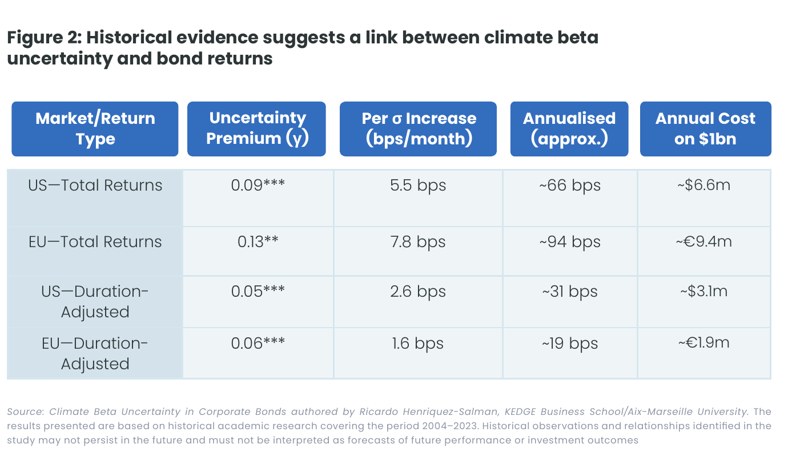
Research from the KEDGE-Candriam 'Finance Reconsidered' Chair argues that this dispersion - climate beta uncertainty - is financially material: bonds with greater uncertainty were historically associated with higher subsequent returns, independent of their measured climate exposure.


For credit investors, the paper therefore asks a more useful question than ‘Which index is right?’: how robust is an issuer's climate assessment across methods, and how much uncertainty should be reflected in spreads, selection and portfolio risk?

The implication is clear: Climate-aware credit analysis should compare several signals, test what drives apparent resilience, and distinguish issuer-specific exposure from duration and sovereign effects.

Climate beta measures how a bond’s returns move with a climate-risk policy.


Key takeaways  

  1. One climate score is not enough. Comparing datasets and methodologies can reveal uncertainty that a single index may conceal.
  2. Major climate or regulatory events may improve price discovery by helping markets reassess which issuers are genuinely exposed.
  3. Duration can look like climate resilience. Investors should separate interest-rate, sovereign and issuer-specific credit effects.
  4. For portfolio construction, a multidimensional approach can combine physical and transition risks with forward-looking indicators and uncertainty analysis.


;
Ricardo Henriquez-Salman
KEDGE Business School / Aix-Marseille University

One of the biggest challenges faced by investors is analysing and interpreting data from numerous industry indices.  

RESEARCH PAPER

Download the paper

See the evidence behind climate beta uncertainty and the practical implications for issuer selection, spread analysis and climate-aware portfolio construction.

Our Investment Solutions

Explore how Candriam combines fundamental, ESG and quantitative research within disciplined portfolio construction across fixed income and the wider investment solutions range.

More on our Investment Solutions

Find it fast

Get information faster with a single click

Get insights straight to your inbox