Executive Summary
Climate exposure is becoming part of credit analysis, yet there is no universally accepted way to measure it. Indices can differ in scope, data and methodology, leaving investors with conflicting climate betas* for the same bond.
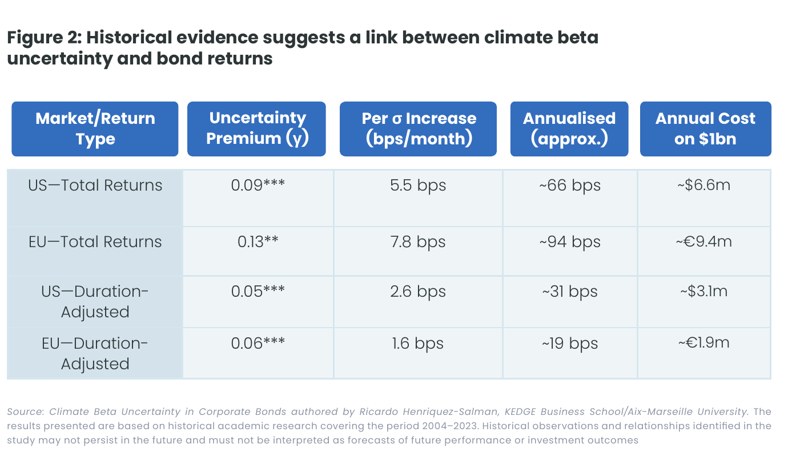
Research from the KEDGE-Candriam 'Finance Reconsidered' Chair argues that this dispersion - climate beta uncertainty - is financially material: bonds with greater uncertainty were historically associated with higher subsequent returns, independent of their measured climate exposure.
For credit investors, the paper therefore asks a more useful question than ‘Which index is right?’: how robust is an issuer's climate assessment across methods, and how much uncertainty should be reflected in spreads, selection and portfolio risk?
The implication is clear: Climate-aware credit analysis should compare several signals, test what drives apparent resilience, and distinguish issuer-specific exposure from duration and sovereign effects.
Climate beta measures how a bond’s returns move with a climate-risk policy.
Key takeaways
- One climate score is not enough. Comparing datasets and methodologies can reveal uncertainty that a single index may conceal.
- Major climate or regulatory events may improve price discovery by helping markets reassess which issuers are genuinely exposed.
- Duration can look like climate resilience. Investors should separate interest-rate, sovereign and issuer-specific credit effects.
- For portfolio construction, a multidimensional approach can combine physical and transition risks with forward-looking indicators and uncertainty analysis.


 ;
;