Important Message: Beware of Impersonation Scams

Fraudulent messages and advertisements are currently circulating on messaging platforms, including WhatsApp, impersonating Candriam’s brand and investment professionals. Please note that Candriam never offers investment recommendations or provides financial advice through social media channels or messaging platforms.

The ECB: From Crisis Fighter to Liquidity Maestro?

The European Central Bank (ECB) has undergone a significant transformation, evolving from a passive observer to a proactive guardian of financial stability in the eurozone. As the ECB normalises its monetary policy after a period of unconventional measures, a key challenge has emerged: managing excess liquidity. This paper explores the ECB's evolving role in addressing this challenge.

The European Central Bank (ECB)’s role has changed dramatically since its inception in the 1990s. Gone are the days of simply watching inflation. Now they're actively managing the financial health of the eurozone.

Remember the Great Financial Crisis of 2008? That's the turning point for the ECB, when it stepped in to prevent a financial meltdown. From there, the ECB created various tools to support the eurozone economy. This came at a cost: excess liquidity.


Eurozone Liquidity: A Trillion-Dollar Surge
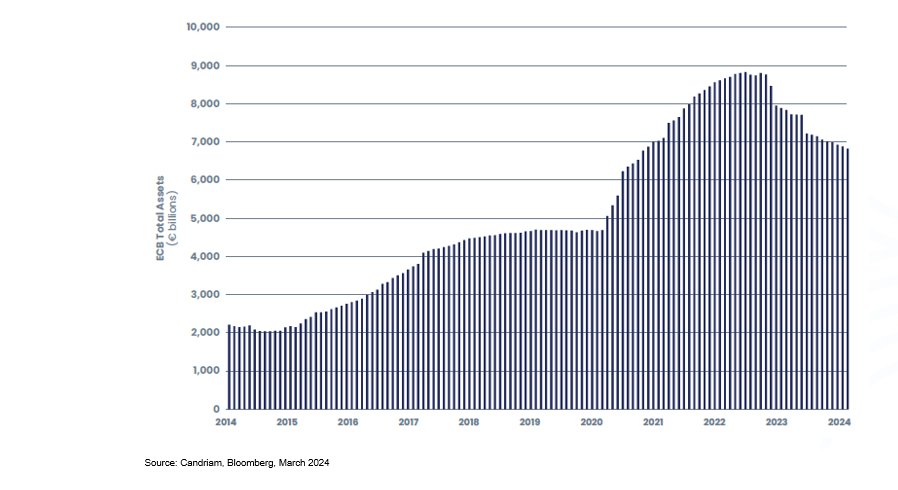
That's the problem the ECB is facing now: how to reduce the excess cash that has flooded into the market as economic conditions no longer lend themselves to the unconventional measures it has implemented over the past decade. Now the Frankfurt-based institution has to find the right balance:

  • Taming inflation without hurting economic growth
  • Mop up excess liquidity without causing financial instability

The ECB's playbook? It's still being written. The ECB is exploring new approaches and rethinking how banks access liquidity.

The ECB's potential future options:

  • A demand-driven system: could banks request liquidity on demand, shifting the dynamic?
  • Hybrid approach: perhaps a mix of "corridor" and "floor" systems is the answer.


A Potential Resurgence of Money Market Funds?

The ECB's tightening grip on the money supply opens the doors for the revival of money market funds as a key player in the European financial system. These funds offer a compelling alternative to traditional bank deposits, particularly in light of a potentially more profitable yield curve. By professionally managing a pool of short-term, high-quality assets, money market funds can help investors weather market volatility and generate income from their cash holdings even in uncertain economic times.

;
Pierre Boyer
Head of Money Market and Short Term at Candriam
As the European Central Bank tightens its grip on the money supply, there's a shift underway that could revive an old favourite: money market funds.

Want to dive deeper?

Download our white paper “Guardian of the Euro Galaxy: the ECB Braces for Liquidity Shift” for the full story.

Related News

  • Unlocking extra income in subordinated financial bonds

    Since the end of February, global credit markets have been driven by the escalation of the US-Iran conflict and rising tensions across the Middle East. While geopolitical risks are not new, the intensity and speed of this episode took markets by surprise.
  • Navigating the Credit Cycle

    If you ask a fixed income investor to describe the credit cycle, most will readily cite its four familiar phases: Repair, Recovery, Expansion and Downturn. Knowing the terminology is straightforward. The more relevant question is: why does it matter for portfolio outcomes?
  • More cautious stance in the near term

    Market dynamics continue to be dominated by geopolitical developments and the evolution of the conflict in the Middle East, primarily via its impact on oil prices.
  • Embracing risk in credit: the Candriam approach

    Explore Candriam’s disciplined approach to credit investing. Learn how issuer research, ESG integration and risk visibility help navigate volatility and construct resilient fixed income portfolios.
  • Emerging Market Debt outlook: what comes next after the rally?

    Emerging market debt has treated investors well lately. Hard-currency sovereigns have benefited from high coupon yields, tighter spreads and a few well-timed recoveries, while corporates have followed a similar script — with high yield doing much of the heavy lifting.
  • Macro backdrop remaining broadly resilient

    We are moving to a neutral stance on US duration this month after our tactical long. While the macro backdrop remains broadly resilient, the balance of risks across the curve has shifted sufficiently to warrant a recalibration of our positioning.

Find it fast

Get information faster with a single click

Get insights straight to your inbox