Skip to main content Skip to header search Skip to header search

Important Message: Beware of Impersonation Scams

Fraudulent messages and advertisements are currently circulating on messaging platforms, including WhatsApp, impersonating Candriam’s brand and investment professionals. Please note that Candriam never offers investment recommendations or provides financial advice through social media channels or messaging platforms.

The AI debt wave

Following the debt behind the AI infrastructure boom

AI and credit: Who ultimately carries the risk?

AI’s infrastructure boom is drawing some of the world’s largest technology companies deeper into debt markets. The rapid shift from internal cash flow to external financing is bringing new borrowers, structures and sources of risk into credit markets. Our latest paper examines how this financing wave is changing corporate credit, increasing passive exposure and spreading risk across data centres, utilities and private markets. For investors, the crucial question is where the obligation ultimately sits if expected returns fail to materialise.
Executive summary

For much of the past decade, hyperscalers could finance substantial investment from their operating cash flows. AI has changed that equation. Capital expenditure could reach $750bn in 2026, with debt expected to finance roughly one third of it.[1]

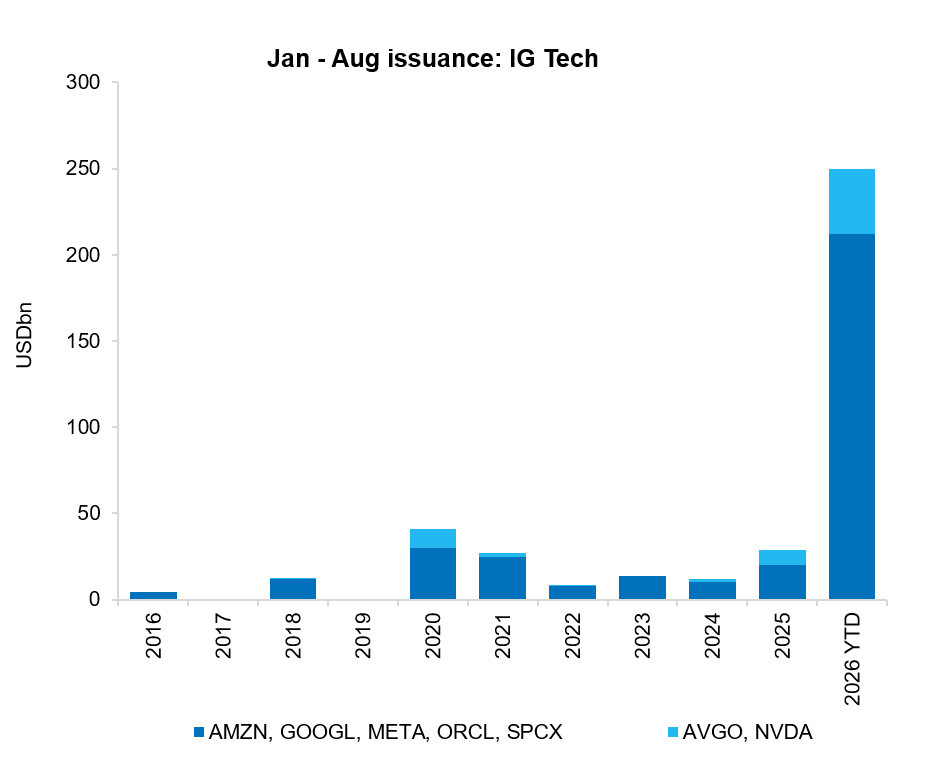
The speed of borrowing is as significant as its size. Investment-grade technology issuance accelerated sharply in 2025 and has reached new highs in 2026[2].

January to August investment-grade bond issuance from Amazon, Alphabet, Meta, Oracle, SpaceX, Broadcom and Nvidia, USD billions.

Source: Candriam, Bloomberg, as at 31 August 2026.

Meanwhile, the financing required extends well beyond hyperscaler bonds. A single data-centre project can create obligations across property owners, utilities, equipment providers and private lenders, while access to power and planning approval can determine when it begins generating cash.

Download the paper

Explore how the AI debt wave is reshaping corporate credit and why understanding cash flow, benchmark exposure and the obligations behind each project matters for investors.

Tame Risk.

Don't run from it. 

Credit can feel calm because returns are steady most of the time. But credit is asymmetric: the upside is limited to the coupon, while the downside can be permanent if fundamentals weaken or liquidity disappears.

Read more

[1] Goldman Sachs, How AI debt is reshaping credit markets, 5 August 2026
[2] Source: Candriam, Bloomberg, as of 31 August 2026.

Find it fast

Get information faster with a single click

Get insights straight to your inbox