

Russia’s invasion of Ukraine exposed the risks of excessive dependence on a single supplier and accelerated Europe’s efforts to diversify the continent’s energy mix. More recent disruptions in the Middle East have reinforced that diversification alone cannot remove exposure to global energy shocks.
The bigger question is therefore no longer simply where Europe buys its energy, but whether it can build the grids, industrial capacity and critical-material supply chains needed for a more secure, competitive and resilient energy system.
The grid is the real bottleneck
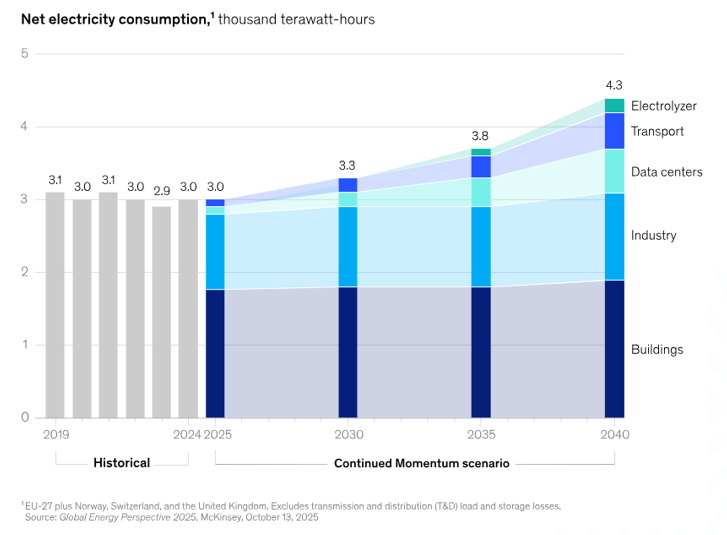
That challenge is becoming more urgent as Europe electrifies. European power consumption is projected to increase by more than 40% from 2025 to 2040[1], driven by electrification across buildings, transport and industry, alongside growing demand from data centres.
European power demand is projected to shift from decline to robust growth through 2040.
Generating that electricity is only part of the equation. Europe must also be able to move it.
An estimated €1.2 trillion investment in electricity networks could be required by 2040, including roughly €730 billion for distribution grids.[1] Around 40% of Europe’s distribution grids are already more than 40 years old[2], while greater cross-border interconnection will also be needed to balance supply and demand across an increasingly electrified system.
In our view, this makes the grid one of the central bottlenecks in Europe’s autonomy ambitions. Financing is only one part of the challenge: permitting delays, equipment shortages and grid-connection constraints are all slowing delivery, while around 120 GW of mature renewable projects could be at risk of not securing timely grid access by 2030.[3]
The result is an implementation gap between Europe’s ambitions for new generation and the infrastructure required to connect and distribute that power. Without the necessary networks, transformers, cables and related equipment, additional generation capacity cannot fully translate into greater energy security.
For investors, this broadens the opportunity beyond renewable generation itself. Network utilities, cable manufacturers, transformer producers, switchgear suppliers and energy-management companies all provide the capabilities required to modernise Europe’s electricity system.
Autonomy is also a competitiveness question
The importance of that investment becomes clearer when viewed through the lens of industrial competitiveness. In 2025, electricity prices for large energy-intensive industrial users in the EU remained more than twice those in the US and around 50% higher than in China.[4]
Estimated final electricity price for large industrial customers in energy-intensive industries, 2019-2025
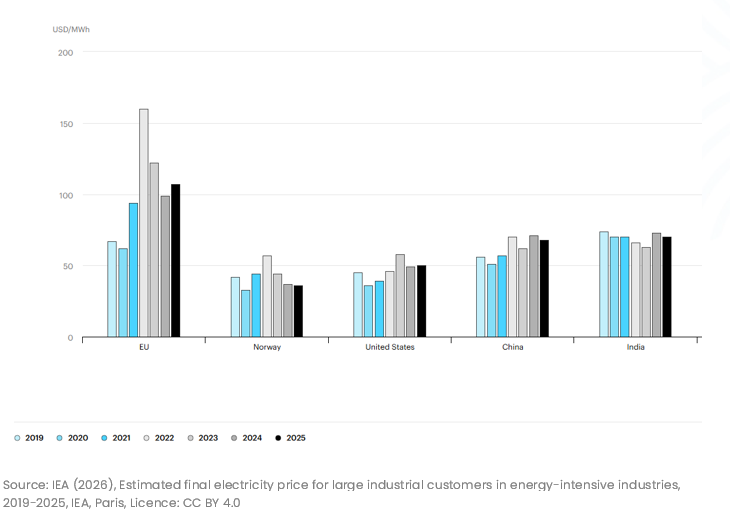
That disadvantage matters for industries such as chemicals, metals and advanced manufacturing, Many of the same industries Europe wants to retain or rebuild as part of its broader autonomy agenda.
A stronger, more interconnected electricity system could improve resilience and help businesses gain access to more competitively priced power. At the same time, grid projects remain exposed to regulatory and permitting delays, renewable developers must secure connections, and equipment manufacturers still face input-cost pressures, competition and execution risk.
In our view, that distinction matters. Structural demand may support an industry, but it does not automatically make every company within it attractive. The ability to supply scarce equipment, secure grid access, manage capital intensity and execute complex projects can determine which companies are best placed to benefit.
The materials paradox
Electrification also introduces another strategic vulnerability: greater dependence on the materials required to build grids, turbines, electric motors and storage.
Europe’s shift away from imported fossil fuels increases demand for copper, rare earths and other strategic materials. China accounted for around 91% of global refining of magnet rare earths in 2024 and 94% of rare-earth permanent magnet production.[5] Export restrictions introduced in 2025 demonstrated how quickly that concentration can become an industrial vulnerability.
Without stronger domestic processing and more diversified supply chains, Europe could therefore reduce its dependence on imported fossil fuels only to increase its reliance on critical materials from a small number of external suppliers. The EU’s Critical Raw Materials Act seeks to respond by increasing domestic extraction, processing and recycling capacity while reducing excessive dependence on any single non-EU supplier.[6]
Yet implementation remains difficult. The Commission has selected strategic projects to expand European capacity, but financing, permitting and technical constraints could limit how quickly many of them contribute to supply. Recycling can also play a greater role, although its contribution remains limited for several critical materials today.
Processing capacity may therefore prove just as strategically important as access to the raw materials themselves.
Autonomy does not mean self-sufficiency
Autonomy does not mean producing every material and component within Europe. It requires a combination of stronger domestic capabilities, diversified sourcing and reliable partnerships with resource-rich countries.
That creates investment opportunities across five parts of the value chain. Network utilities provide exposure to the long-term grid investment cycle, while electrical equipment manufacturers supply the transformers, cables, switchgear and energy-management systems needed to expand and modernise networks. Renewable developers with permitted projects and secured grid connections may also have an advantage in bringing new capacity online.
Further upstream, critical-material processors can help address strategically important gaps in European supply, while recycling companies can recover materials already within the European economy and reduce reliance on primary imports. Across these areas, existing infrastructure, scarce technical capabilities and the ability to execute at scale can become important competitive advantages.
At Candriam, exposure to the theme is only the starting point. We assess whether companies can translate these structural needs into profitable growth, considering their competitive position, management quality, financial strength, capital requirements and valuation.
Building the system, not simply changing the source
Europe’s energy autonomy challenge is much broader than replacing imported fossil fuels with domestic renewable generation. It will depend on whether Europe can build the grids, industrial capacity, equipment and critical-material supply chains needed to support a more electrified economy. These elements are interdependent: generation without infrastructure, infrastructure without equipment, or electrification without secure access to materials would leave important vulnerabilities unresolved.
For investors, this creates opportunities across the energy value chain, but they will not be distributed evenly. In our view, the companies best placed to benefit may be those solving Europe’s practical bottlenecks: connecting new generation, supplying scarce electrical equipment, processing strategic materials and recovering resources already within the European economy.
Europe has defined much of what it wants to build. The investment question is now which companies have the capabilities to deliver it profitably.
[1] Communication from the EU Commission to the European Parliament, European Grids Package, 12 December 2025
[2] European Commission, EU Action Plan for Grids; European Commission, Electricity interconnection targets, estimates from 2023
[3] European Commission, European grids, 2026
[4] International Energy Agency, Electricity 2026 – Prices, February 2026
[5] International Energy Agency, With new export controls on critical minerals, supply concentration risks become reality, October 2025
[6] European Commission, Critical Raw Materials Act - Internal Market, Industry, Entrepreneurship and SMEs


Key takeaways
-
The grid is becoming the critical bottleneck. Europe can add generation capacity, but without faster investment in networks, interconnection and electrical equipment, much of that power cannot reach where it is needed.
-
The dependency challenge is shifting. Electrification reduces reliance on imported fossil fuels but increases Europe’s need for critical materials, processing capacity and resilient supply chains.
-
For investors, implementation matters. The opportunity spans utilities, electrical equipment, renewables, critical materials and recycling. The strongest positions may nevertheless belong to companies with scarce capabilities, existing infrastructure and the ability to execute.