Following the technology- and momentum-led correction in July, global equity markets resumed the upward trend seen since the beginning of the year. The recovery extended beyond US technology, with positive returns across developed and emerging markets. Resilient economic activity and a strong earnings season helped investors look through persistent geopolitical uncertainty and rising long-term bond yields.
Higher yields aren’t necessarily negative
Investors tend to see rising long-term yields as a negative factor for equity market performance. However, this hasn’t been always the case. Historically, the impact of higher interest rates has always depended on both the cause and speed of the increase. A gradual rise driven by stronger economic growth can be absorbed, as improving revenues and earnings compensate for the higher discount rate. Rapid increases or moves driven by inflation, fiscal concerns and a higher term premium appear to be more challenging.
The US market illustrates this balance. Since March, the US 10-year Treasury yield has risen by more than 80 basis points to around 4.8%, yet the S&P 500 remains more than 11% higher than at the beginning of the year.[1] Strong earnings growth has so far overshadowed the pressure from higher yields and helped bring valuations down from their early-year levels without derailing the equity market. This resilience has clearly been supported by a strong earnings outlook across all major equity regions, although the balance between earnings growth and valuation differs considerably.

Has investors’ focus shifted beyond earnings?
However, with the strong second-quarter reporting season largely behind us, investor attention may shift back towards macroeconomic developments. A further rapid rise in yields, particularly towards the psychologically important 5% level, could put renewed pressure on valuation multiples and long-duration equities. Higher yields may therefore become a more visible source of volatility in the short term, even if earnings remain the fundamental driver of equity markets.
The current increase in yields reflects a combination of resilient economic growth, sticky inflation, elevated energy prices and concerns around fiscal credibility. This creates a more demanding market backdrop, but it does not fundamentally change the central equity story. As long as earnings continue to grow sufficiently, markets can absorb gradually higher yields. The key risk would be a sharp rise in rates that is not accompanied by stronger growth or earnings.
Investment implications
In this environment, we remain focused on structural growth, but earnings delivery is becoming more important. Higher yields raise the bar for long-duration equities, particularly for companies whose valuation depends on profits far into the future. We therefore favour companies combining visible earnings growth and cash flow generation with strong balance sheets and reasonable valuations. This remains supportive for selected opportunities in Technology, Healthcare, Utilities and Industrials, linked to AI, healthcare innovation, electrification and grid investment.
From market drivers to portfolio positioning
The impact of higher yields will not be uniform across regions or sectors. Markets with stronger earnings growth are better placed to absorb a higher discount rate, while expensive and interest-rate-sensitive segments remain more vulnerable. We therefore assess regional and sector positioning based on the interaction between earnings momentum, valuations, balance sheet strength and exposure to structural growth opportunities.
United States
The US market sits at the centre of this trade-off. Strong earnings delivery and positive revisions continue to support the outlook, while the rise in earnings expectations has allowed valuations to ease despite the market advance. However, at 19.2 times forward earnings,[2] the US remains more expensive than other major regions and therefore more sensitive to a further rapid increase in long-term yields. This combination supports a constructive but increasingly selective stance.
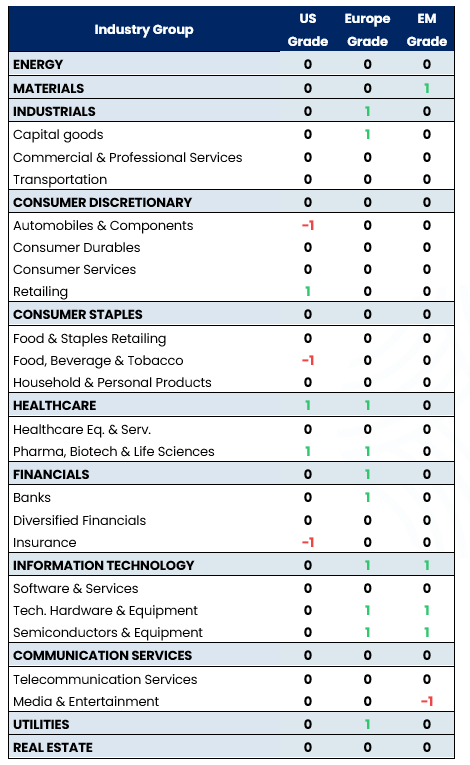
At sector level, the changing interest rate environment led us to downgrade utilities from overweight to neutral. Higher long-term yields increase financing costs and reduce the relative attractiveness of the sector, while political and permitting uncertainty creates additional risks around the funding and execution of grid investment.
- Healthcare remains one of our highest-conviction sectors, with a particular focus on biotechnology. Continued innovation, M&A and strong earnings growth expectations support our positive stance.
- Information Technology remains a strong strategic conviction, supported by continued AI infrastructure investment and robust demand for semiconductors and technology hardware. Earnings growth expectations remain strong, while the easing in valuations strengthens the longer-term investment case. However, uncertainty around the scale of AI capital expenditure and its eventual monetisation warrants some tactical caution. We therefore maintain a neutral sector grade while retaining our positive strategic view.
Europe
Despite strong Q2 results supporting positive earnings revisions, European equities pulled back from the record highs reached earlier in the summer. This correction was primarily driven by escalating geopolitical tensions in the Middle East, which pushed crude oil prices higher. Energy was consequently the best-performing sector, while all sectors other than Materials and Financials delivered negative returns. European equities continue to trade at a reasonable valuation of around 15 times 12-month forward earnings.[3] Against this backdrop, we made some changes:
- At sector level, we have upgraded banks from neutral to overweight, supported by expected rate hikes in Europe, ongoing consolidation, accelerating growth and resilient margins. This also led us to upgrade Financials, as banks account for 59% of the sector in Europe.
- We have also upgraded capital goods from neutral to overweight, given strong structural demand for electrification, power generation and grid modernisation. In addition, momentum in aerospace has strengthened, supported by large order backlogs. This led us to upgrade Industrials, as capital goods account for 86% of the sector in Europe.
- Lastly, we have upgraded automobiles & components from underweight to neutral, reflecting limited downside risk to German carmakers’ earnings, recent news on EU trade protection and attractive valuations following the sector’s underperformance year-to-date.
We have maintained all other grades and retain our positive stance on European Healthcare, Information Technology and Utilities. Within Healthcare, we continue to favour pharmaceuticals, biotechnology & life sciences. Utilities should continue to benefit from structural growth drivers, notably electrification and rising grid investment, while valuations remain reasonable.
Emerging markets
We have made no changes to our grades on emerging market equities and maintain a constructive view of the region that offers a favourable combination of earnings growth and valuation. This provides some protection against higher global yields. However, the outlook remains sensitive to the direction of US real rates and the dollar, making country and sector selection particularly important.
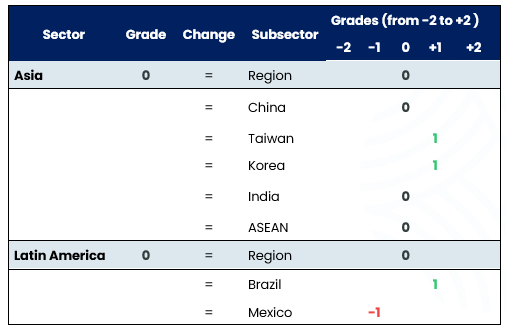
Strong AI fundamentals continue to favour Asian technology, particularly in Korea and Taiwan, while persistent macroeconomic weakness and softer corporate fundamentals warrant greater caution in China. Elevated commodity prices and the potential for US dollar weakness are also broadening opportunities beyond technology, notably towards Brazil and selected resource-related exposures.
- Korea and Taiwan remain our preferred emerging markets. Lighter investor positioning, rising memory prices and positive earnings revisions reinforce the fundamental case, with a clear preference for hardware and semiconductors given their strong earnings visibility.
- We are becoming more cautious on China and are taking profits, as weak macroeconomic fundamentals become increasingly visible. Record-low bank margins, subdued credit creation and dilution linked to recapitalisation continue to create headwinds.
- Improving commodity dynamics are creating additional opportunities. Brazil remains our preferred market, supported by higher metals and energy prices, potential US dollar weakness and favourable election optionality. Mexico remains less compelling, supporting our preference for Brazil over Mexico. Within sectors, –Energy is benefiting from elevated oil prices, while Materials could gain from softer US inflation, lower real yields and a weaker dollar.
Global convictions
The table below summarises our current highest-conviction regional, country and sector positioning following the latest Strategic Equity Committee.
[1] Source: Bloomberg© as at 03/09/2026
[2] Source: Bloomberg© as at 03/09/2026
[3] Source: Bloomberg© as at 03/09/2026


