


Solid growth is giving central banks more room to be hawkish. The economy has absorbed the Iran war and higher energy prices better than feared. Inflation has risen less sharply than expected, but its persistence is keeping policymakers on their guard. Central banks have put on their hiking boots and bond yields have followed. Stronger activity should support earnings, but it also reduces the pressure on central banks to ease while inflation remains too high.
After the August rally, we have become more prudent. Corporate fundamentals support our investment convictions, while we have become more demanding about the risks we take, given higher yields. We have therefore selectively protected gains and adjusted exposures within broadly unchanged allocation grades.
A smaller shock, a longer squeeze
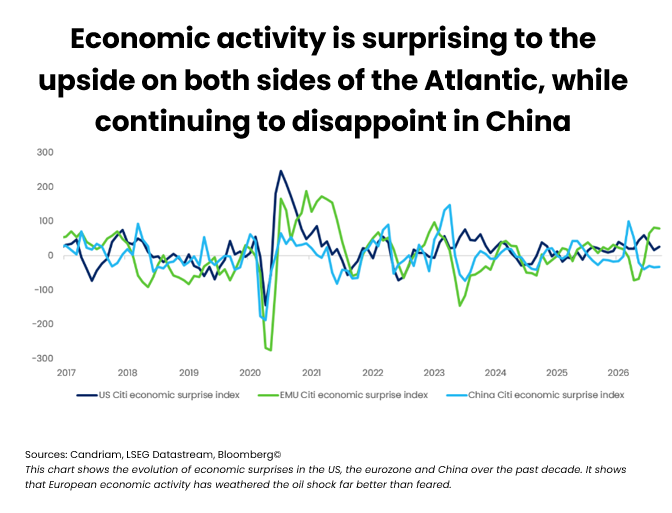
The economy has found ways around some of the disruption. Rerouting, inventory drawdowns and additional oil supply outside the Middle East have softened the impact of impaired shipping through Hormuz and the Arabian Peninsula. Investment has also held up: US capital spending is broadening beyond AI, while European business surveys and demand expectations have also improved.
That adaptation helps explain why activity has surprised positively on both sides of the Atlantic. It does not remove the energy constraint. Refining bottlenecks are keeping transport fuels expensive, and low European gas stocks leave the region exposed ahead of winter. Crude prices alone give an incomplete account of the costs reaching businesses and households. Consumer sentiment indicators are starting to reflect these strains, putting the recovery in spending power under closer scrutiny as winter approaches.
The length of inflation's duration now deserves as much attention as its peak. Underlying price pressures are easing gradually, but energy costs remain high and growth is firm enough to give central banks room to act. We expect limited but broad-based tightening this year and next. The timing and the pace at which inflation recedes significantly will determine how far central banks need to go.
Our central scenario remains one of continued expansion, with US growth slightly above 2% and a modest European recovery, delivering close to 1% GDP growth. Investment is doing much of the work. US consumption relies partly on household savings, while Europe's recovery still depends heavily on public spending in Germany. China's weak domestic demand adds to the case for distinguishing investment beneficiaries from businesses dependent on a broad consumer rebound.
The earnings support is real
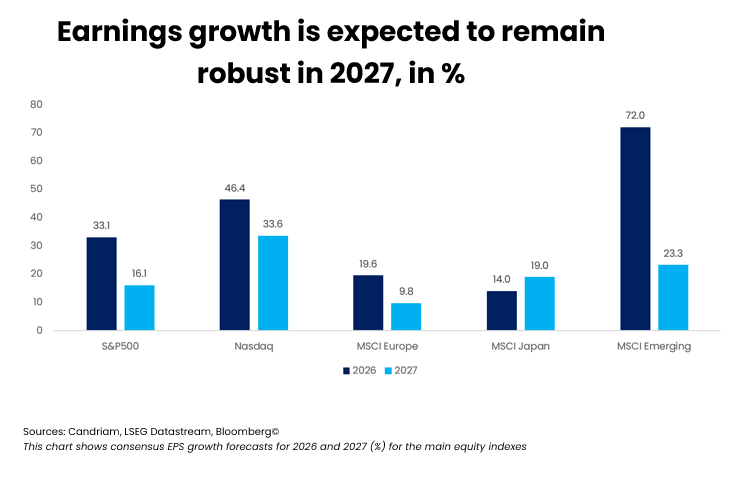
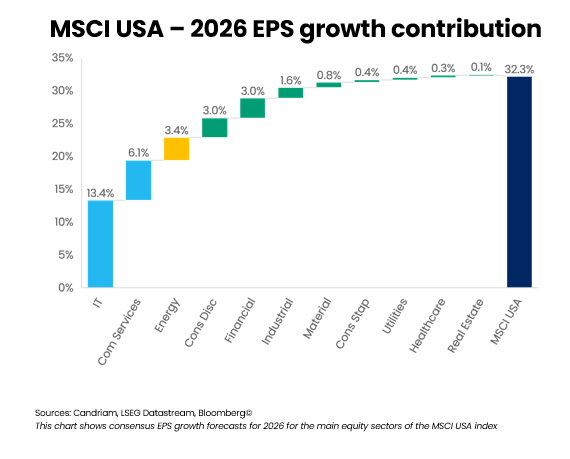
Second-quarter results have strengthened the case for equities. Earnings growth has broadened beyond technology, and estimates have moved higher across the main regions. Companies have continued to deliver despite the energy shock. This gives us a reason to maintain exposure even as the interest rate hurdle rises.
The next reporting season will test whether that earnings momentum can extend into 2027. Expectations have risen with the rally, leaving less room for disappointment. We will watch whether higher energy costs start to erode margins and whether management teams maintain their investment plans.
Within AI, converting orders into revenues and cash will become a more demanding test. Hyperscalers backlogs are growing faster than revenues, but investment continues to weigh on free cash flow expectations. Suppliers of scarce capacity can capture part of that spending before the companies financing it earn a return. Memory, advanced packaging and power infrastructure remain areas of interest. The software rebound is already rewarding companies monetising AI. Sustaining it will require evidence that those revenues can grow.
Earnings are broadening outside the familiar technology leaders. Electrification, automation and selected industrial businesses benefit from investment programmes, with improving conventional equipment demand providing further support. A further broadening of earnings would give the equity advance a wider base. Owning the same investment theme in several markets, however, does not necessarily diversify its risks.
Higher yields change the bargain
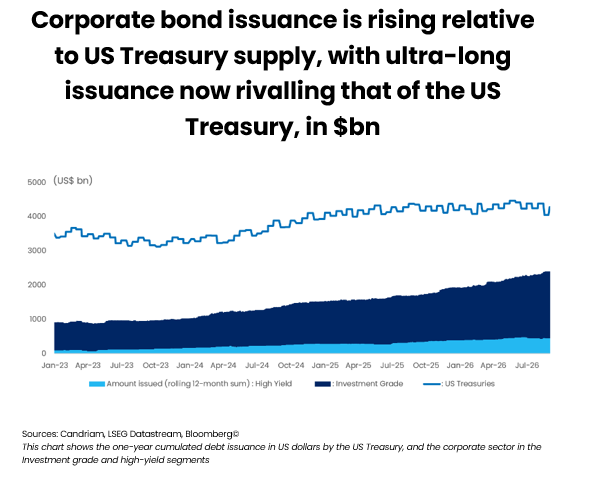
Central banks are only part of the explanation for higher yields. Governments continue to borrow heavily, and corporate issuance is increasing as investment needs grow. Bond markets must absorb both. Even a pause in policy tightening would leave these financing demands in place; clearly, the AI investment cycle is reshaping credit markets, especially on large-scale debt financing.
Higher yields offer better entry points in selected sovereign maturities. We retain a neutral overall bond stance and a preference for core European debt, where market pricing already allows for considerable policy tightening. This is a selective duration position, with attention to the price paid for protection.
Credit offers less scope for enthusiasm. Much of the improvement in fundamentals is already reflected in tight spreads. Equity investors can participate in rising profits; bondholders have more limited upside once spreads have compressed. We prefer European investment grade to US investment grade, we remain cautious on US high yield and retain a positive view on emerging-market local-currency debt. Carry is useful, but it does not erase interest rate or refinancing risk.
Some gains are worth protecting
We remain slightly overweight equities, with preferences for Japan and emerging markets and neutral grades for the United States and Europe. Japan offers exposure to the investment cycle alongside improving governance and domestic support. Asian earnings momentum and valuations underpin the emerging market allocation, with China's weaker domestic economy requiring selectivity.
Europe's energy dependence remains a constraint on our regional appetite. Stronger activity has not removed that vulnerability, which supports some preference for US exposure within our recent adjustments. Across portfolios, we have moderated risk after the rally, while retaining the underlying investment convictions. September's difficult historical seasonality in a US midterm year reinforces that prudence alongside positioning and higher yields. The calendar informs the size of our exposures; it does not determine the investment case.
Precious metals remain part of the allocation, supported by our scarcity convictions, alongside liquid alternative strategies. With several assets exposed to rising yields, diversification requires attention to common risks across the portfolio. For now, we keep exposure to businesses delivering growth and take some gains where markets have rewarded us. Firm convictions leave room for a lighter risk budget.
Candriam House View & Convictions
The table below is an indicator of the main exposures and movements within a balanced diversified model portfolio.
Legend
-
Strongly Positive
-
Positive
-
Neutral
-
Negative
- Strongly Negative
- No Change
- Decreased Exposure
- Increased Exposure
| Current view | Change | |
|---|---|---|
| Global Equities |
|
|
| United States |
|
|
| EMU |
|
|
| Europe ex-EMU |
|
|
| Japan |
|
|
| Emerging Markets |
|
|
| Bonds |
|
|
| Europe |
|
|
| Core Europe |
|
|
| Peripheral Europe |
|
|
| Europe Investment Grade |
|
|
| Europe High Yield |
|
|
| United States |
|
|
| United States |
|
|
| United States IG |
|
|
| United States HY |
|
|
| Emerging Markets |
|
|
| Government Debt HC |
|
|
| Government Debt LC |
|
|
| Currencies |
|
|
| EUR |
|
|
| USD |
|
|
| GBP |
|
|
| AUD/CAD/NOK |
|
|
| JPY |
|
Monthly Coffee Break
Updated each month, this section provides expert analysis and strategic insights. Stay informed with our latest market perspectives and allocations.
-
 Monthly Coffee Break, Alternative Investments
Dispersion and Trends Drive Opportunities
September was characterised by resilient global economic activity, persistent inflationary pressures and increasing concerns over monetary tightening and geopolitical risks. In the United States, economic momentum remained robust, supported by AI-related investment and resilient consumption, despite signs of labour market moderation. In Europe, economic indicators continued to improve, with manufacturing and services PMIs signalling greater resilience. -
 Monthly Coffee Break, Asset Allocation
Earnings take centre stage
The Fed has delivered a hike where investors just months ago expected cuts. Markets now anticipate further tightening through 2027, yet US equities remain higher this year. Earnings expectations have held up through the reversal in monetary expectations. The upcoming Q3 reporting season will show whether companies can deliver on them. -
 Monthly Coffee Break, Fixed Income
Maintaining duration overweight on EUR rates
We retain a modest duration overweight in the two-to-five-year segment after September's sharp sell-off. Higher real yields have made valuations more appealing, but we keep conviction limited. Our strongest argument remains monetary policy: markets discount a terminal Fed rate around 4.75% , leaving room for a less extensive tightening cycle to support shorter maturities. -
 Monthly Coffee Break, Equities
The earnings test
After a period in which strong earnings helped equities absorb rising interest rates, higher bond yields have begun to weigh more on equity sentiment. The third-quarter reporting season will now test whether companies can sustain market confidence through solid results and credible guidance. Earnings expectations continue to rise, providing an encouraging starting point, while also raising the bar for companies to deliver.