
Important Message: Beware of Impersonation Scams

Fraudulent messages and advertisements are currently circulating on messaging platforms, including WhatsApp, impersonating Candriam’s brand and investment professionals. Please note that Candriam never offers investment recommendations or provides financial advice through social media channels or messaging platforms.

Are emerging markets becoming a source for resilience?

For decades, investors tended to view the world through a consistent lens; developed markets offered stability, while emerging markets offered the potential for rapid growth, albeit with greater volatility and risk. That distinction is becoming less obvious.

Political fragmentation, rising fiscal pressures, social polarisation and energy security concerns have become increasingly prominent across many developed economies. Supply chain disruptions and industrial dependencies have also exposed vulnerabilities that were once more commonly associated with emerging markets. Stability in developed markets has not disappeared, but it can no longer be taken for granted.

At the same time, parts of the emerging world have evolved considerably. Countries such as Taiwan and South Korea sit at the centre of global semiconductor supply chains. India is investing heavily in infrastructure, manufacturing and digitalisation, supported by favourable demographics and rising domestic consumption. Across emerging markets more broadly, governments and companies are investing in renewable energy, power infrastructure and strategic industries with a longer-term perspective than many investors may realise. Importantly, many emerging market companies are not only benefiting from these trends but are also helping developed economies navigate their own energy transition, supplying critical technologies, materials and infrastructure linked to electrification, renewable energy and grid modernisation.

This does not mean that emerging markets have become risk-free, nor that developed markets have lost their advantages. But it does suggest that some of the assumptions underpinning global asset allocation deserve to be revisited. In our view, this changes the investment case. The opportunity is less about buying the index and more about identifying the parts of the asset class where structural growth, earnings visibility and valuation discipline meet.

  •  Paulo Salazar - Head of Emerging Markets Equity | Candriam
    Paulo Salazar
    Head of Emerging Markets Equity

Technology: the story hidden inside AI

The AI trade is often discussed through a US lens. Yet much of the physical infrastructure that allows AI to scale sits in emerging Asia.

Taiwan and South Korea, for example, are not simply technology exporters. They occupy critical positions within the global semiconductor ecosystem, supplying the chips, memory and hardware infrastructure required to support AI, cloud computing and advanced manufacturing. As AI investment accelerates globally, many of the beneficiaries sit within emerging market indices rather than the US technology sector itself.

This is a major shift. Emerging markets were once viewed mainly as beneficiaries of global growth or commodity cycles. Today, they can provide exposure to parts of the innovation chain that are difficult to replicate elsewhere.

AI infrastructure spending flows through to Asian memory chipmakers, semiconductor manufacturers, hardware suppliers, equipment companies, power infrastructure and data-centre-related businesses. But in semiconductors, connectivity and the physical ecosystem around digitalisation, emerging markets play an increasingly important role.


Energy security is reshaping investment priorities

Energy security has also returned as a central investment theme. The conflict in Iran has again shown that higher or more volatile oil prices can affect emerging markets in very different ways.

Commodity-producing markets may benefit from stronger export revenues and improved fiscal flexibility. Brazil offers exposure to several themes linked to energy security, including oil production, electricity infrastructure and renewable power generation. Chile remains the world’s largest copper producer[1], making it closely linked to long-term investment in electrification, grid expansion and renewable energy. Parts of the Middle East may also benefit from stronger energy revenues, supporting investment and infrastructure spending.

Not all emerging markets benefit equally. Energy-importing economies such as India and Türkiye remain more exposed to higher oil prices through inflation and external balances.

But the most interesting development may be the investment response. Governments and companies are diversifying energy sources, strengthening grids and accelerating investment in domestic infrastructure. Across emerging markets, capital is being allocated to renewable power, grid infrastructure and energy efficiency as countries seek to improve resilience and reduce dependence on imported fuels.

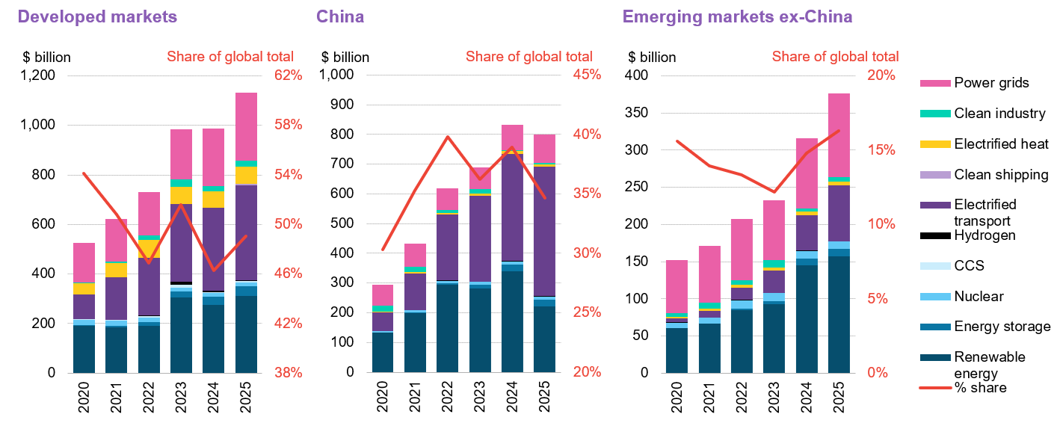
Emerging markets investment is rising

Energy transition investment, by market level

Source: Bloomberg NEF, January 2026

This broadens the opportunity beyond traditional energy producers. India is rapidly expanding solar capacity and electricity infrastructure to strengthen energy security and reduce dependence on imported fuels. China has established a global leadership position across renewable energy technologies, batteries and grid infrastructure, supported by decades of investment and industrial policy. Across the Middle East, governments are investing in large-scale solar, wind and grid projects as part of broader efforts to diversify economies and strengthen long-term energy resilience.

For investors, the opportunity is not simply about identifying who produces energy. It is increasingly about identifying the companies helping build a more resilient energy system through solar and wind generation, power transmission, grid modernisation, battery storage and electrification.

The new engines of emerging market growth

China remains too important to ignore, but it should no longer dominate the emerging market conversation. Its recovery remains uneven, with investor attention concentrated in AI and semiconductor-related technology and selected industrial areas. Property remains fragile despite stabilisation, while consumer recovery is gradual and earnings pressure is still visible in areas such as e-commerce and food delivery.

That does not remove the opportunity. It changes the way investors should approach it. While China faces well-documented challenges in property and consumer demand, it continues to invest heavily in areas aligned with long-term national priorities, including semiconductors, automation, renewable energy and advanced manufacturing. These sectors remain important drivers of innovation and industrial upgrading.

Looking beyond China brings two structural stories into sharper focus. The first is technology: Taiwan and South Korea represent the semiconductor and hardware infrastructure on which AI and digital transformation depend.

The second is demographics. India and parts of south-east Asia benefit from significantly younger populations than most developed economies, supporting labour force growth, rising incomes and expanding domestic consumption. These demographic advantages manifest themselves in different ways across the region, creating opportunities in manufacturing, infrastructure, financial inclusion and consumer-led growth.

The opportunity is not limited to Asia. Mexico has a clear link to nearshoring, as companies seek to reduce dependence on single-country supply chains. Brazil offers exposure to financials, utilities, commodities and renewable energy. In Latin America, financial inclusion remains an important theme, supported by underpenetrated banking systems and growing digital adoption. In EMEA, selected opportunities are linked to renewables, infrastructure and financial convergence.

Together, these markets reduce reliance on a single country, a single sector or the global technology cycle.

Valuations add support

The fundamentals are changing at a time when valuations remain below developed markets. That combination matters.

Emerging market equities continue to trade at a discount to developed markets after several years in which global portfolios remained heavily tilted towards US equities. Recent flows suggest investors are beginning to reassess the asset class. After years of underweighting, even modest reallocations could generate meaningful capital flows into emerging markets.

Selectivity remains key

Emerging markets are now more diverse, more technology-oriented and more closely tied to shifts in global trade, finance and energy security.

Overall, for EM, the combination of structural growth exposure, cyclical leverage, valuation support, and relatively light investor positioning presents a compelling case for reallocation. In an environment defined by geopolitical uncertainty but resilient fundamentals, EM are not only weathering shocks more effectively but are gradually positioning themselves as key contributors to a broadening and more balanced global equity cycle.

Find it fast

Get information faster with a single click

Get insights straight to your inbox