Skip to main content Skip to header search Skip to header search

Important Message: Beware of Impersonation Scams

Fraudulent messages and advertisements are currently circulating on messaging platforms, including WhatsApp, impersonating Candriam’s brand and investment professionals. Please note that Candriam never offers investment recommendations or provides financial advice through social media channels or messaging platforms.

The transition's next challenge: beyond clean energy

The environmental transition is often presented as a clean-energy story. However, as electrification scales, a different question is becoming more important: can the global economy secure, reuse and manage the resources needed to make the transition possible?

Clean energy remains central. Renewable power, batteries, grids and electrified transport are still at the heart of decarbonisation. Yet the transition is broad. It depends on materials, water systems, cooling systems, recycling capacity, industrial equipment and digital technologies that allow resources to be used more efficiently.

This is where the next stage of the transition may be defined. The challenge is no longer only to produce cleaner energy. It is also to build a more resource-efficient economy.

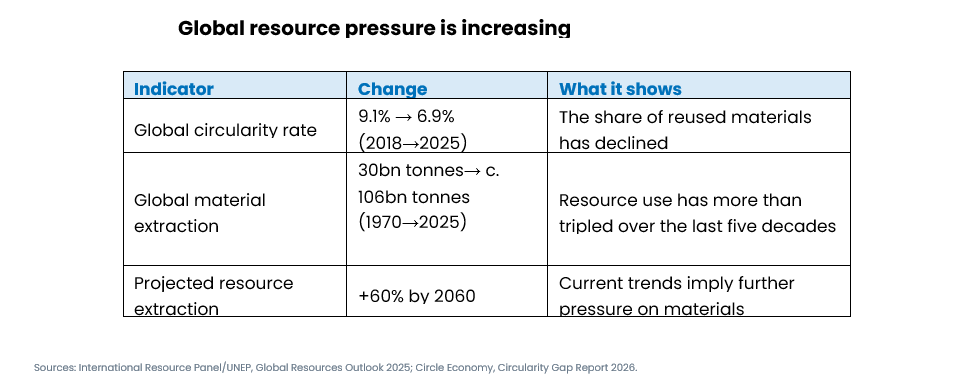
Global material extraction has more than tripled over the last 50 years, and current trends point to further pressure over the coming decades.[1] That matters because many of the technologies enabling decarbonisation are themselves resource intensive. Grids need copper, steel, cables and transformers. Batteries require critical minerals. Data centres need semiconductors, cooling systems and reliable power infrastructure.

This does not undermine the case for the environmental transition, but it does reinforce the need to think about it differently.

  • Ken Van Weyenberg - Head of Client Portfolio Management Equity
    Ken Van Weyenberg
    Head of Client Portfolio Management Equity

Circularity: from waste reduction to strategic resilience

Circularity is often associated with recycling, but that is only part of the story. A circular economy also involves product redesign, repair, reuse, material recovery, automated sorting, advanced packaging and more efficient industrial processes. The objective is to reduce dependence on raw materials and keep more value within the economy for longer.

The scale of the opportunity remains significant. The share of materials reused by the global economy has declined in recent years, from 9.1% in 2018 to 6.9% in 2025.[2] In other words, circularity is becoming more widely discussed at precisely the moment when the economy is becoming less circular.
 

For businesses, this can become a competitiveness issue. Reducing material intensity may help limit exposure to commodity volatility, supply disruption and regulatory pressure. Improving recovery and reuse can also support more resilient industrial models.

For investors, the opportunity is not limited to traditional waste management. It may extend to companies supplying industrial automation, material-recovery systems, sensors, software, recycling equipment and advanced manufacturing technologies. These are the systems that can help turn circularity into practical circular industrial solutions.


Water is becoming an industrial issue

Water is often discussed as a social and environmental challenge. Increasingly, it is also becoming an economic one.

More than 2 billion people still lack safely managed drinking water, while around 3.5 billion lack safely managed sanitation.[3] At the same time, water scarcity is increasingly relevant for industrial capacity, infrastructure planning and supply-chain resilience. The World Bank has estimated that water scarcity could cost some regions up to 6% of GDP by 2050.[4]

The investment implications are broad:

  • Ageing networks need to be upgraded;
  • Leakage needs to be reduced;
  • Treatment and reuse capacity need to expand.

Industrial users need systems that allow them to recycle water, reduce consumption and operate more reliably in water-stressed regions.

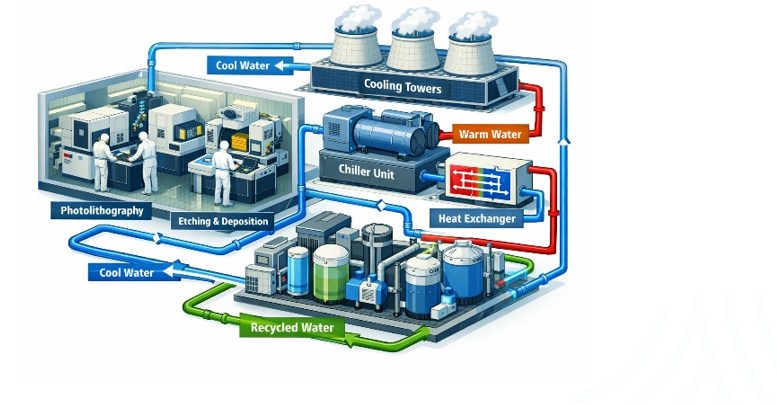
Semiconductors offer a useful example. Advanced chip manufacturing depends on highly controlled environments, stable cooling and large volumes of ultra-pure water. Efficient cooling, heat exchange, treatment and recycling are not peripheral sustainability measures. They can be central to productivity, reliability and cost control.

How cooling and water systems support semiconductor manufacturing

As demand for semiconductors rises - driven by AI, electrification and digital infrastructure - water and cooling systems become part of the physical investment case behind the environmental transition.

From environmental pressure to operational performance

One of the most important shifts is how companies view environmental investment. Measures that were once treated mainly as compliance costs are increasingly being assessed through the lens of efficiency, resilience and competitiveness.

In our view, three types of companies are particularly relevant.

  • Enablers: providers of the equipment, components and software needed to improve energy, water and material efficiency.
  • Efficiency leaders: established businesses reducing resource intensity and potentially improving operational resilience.
  • System integrators: companies able to design, build and operate complex infrastructure across energy, water and industrial systems.


Together, these groups show why the environmental transition should not be viewed as a single theme. It is a structural change in how the economy produces, consumes and allocates resources.

Clean energy remains the backbone. But the next phase may increasingly be shaped by the systems that allow the global economy to do more with less.

For investors, the question is not only who produces cleaner power. It is also who helps make growth less resource-intensive, more resilient and better aligned with the physical constraints of the global economy.

The Environmental Transition

An in-depth exploration of the environmental transition as a multi-decade investment opportunity, examining how decarbonisation, circularity and water security are reshaping industries, infrastructure and capital allocation. Discover:

  • With economics increasingly driving the transition, the opportunity is extending far beyond traditional climate solutions.
  • Understanding where long-term value creation is emerging will be key to navigating the next phase of growth.


Read our white paper

Learn more about how Candriam’s thematic equity strategies address these long-term trends

[1]Source: International Resource Panel/UNEP, Global Resources Outlook 2024
[2]Source: Circle Economy, Circularity Gap Report 2026
[3]Source: UNESCO, United Nations World Water Development Report 2024.
[4]Source: World Bank, High and Dry: Climate Change, Water, and the Economy.

Explore our series on the Environmental Transition :

  • Light art installation with cables and fiber optics in an underground parking, illustrating networks, connectivity and data

    A transition gaining speed

    The environmental transition has entered a new phase. What was once seen as a gradual, policy-led shift is unfolding as a faster, economically driven transformation. Technology, cost dynamics and rising physical risks are converging, turning environmental change into a central force redefining growth, capital allocation and corporate strategy.

Find it fast

Get information faster with a single click

Get insights straight to your inbox