Next Stop: Biodiversity
Our planet’s biodiversity – the variety of species of animals and plants – is collapsing. Given that about half of the global GDP is highly dependent on nature, the consequences can be grave.
According to the World Economic Forum’s 2022 Global Risks Report, biodiversity loss is one of the top three risks in terms of likelihood and impact in the next 10 years[1].
The new sustainability frontier?
Our civilisation now takes from our planet 56% more than it can regenerate[2]. The decline of natural assets will cost the world at least £368 billion a year - adding up to almost £8 trillion by 2050 - roughly equivalent to the combined economies of the UK, France, India and Brazil[3].
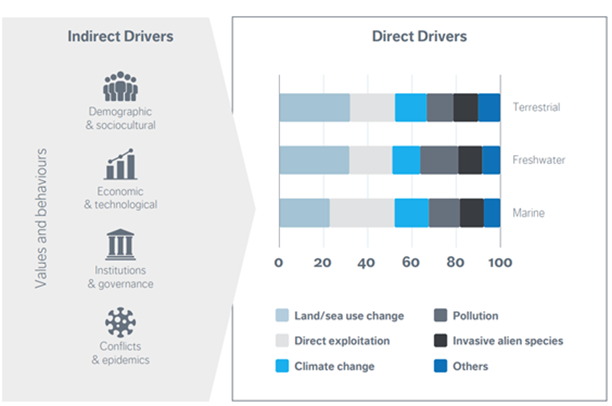
Moreover, the effects of human consumption (the five key colour-coded drivers in our chart) are becoming more powerful, spired by exponential population growth, more people joining the middle class with its wealth aspirations, and the wasteful use of natural resources.
Drivers of Biodiversity Loss
Read our new paper to learn the full story of this challenge and see how it can be addressed:
- The scale and key drivers of biodiversity loss globally
- Its effect on markets and the global economy
- What types of investments could potentially encourage positive change
The level of investments needed to make a real difference
[1] https://www3.weforum.org/docs/WEF_The_Global_Risks_Report_2022.pdf
[2] https://www.wwf.fr/sites/default/files/doc-2020-09/20200910_Rapport_Living-Planet-Report-2020_ENGLISH_WWF-min.pdf
[3] https://www.wwf.org.uk/press-release/launch-new-global-futures-report
Articles related to biodiversity
-
Impact investments have kept rising over the past decades, reaching $1.6 trillion USD according to the Global Impact Investing Network (GIIN) – that is $ 1.6 trillion USD in assets allocated toward solutions supporting the Sustainable Development Goals. -
Can We Assess Companies’ Ecological Debt? And How?
While, according to the World Economic Forum, half of the global GDP is dependent on nature, biodiversity is experiencing an extinction that challenges the resilience of our economies. Deterioration of air, water and soil quality, decline in ecosystem services such as pollination: the physical impacts of this loss of biodiversity are already putting our economies under pressure. -
2030, INVESTING TOMORROW: Meeting urgent environmental and social challenges
Launched in autumn 2024, the Think Tank "2030, Investir Demain" was created at the initiative of L'Info Durable (ID) and L'Agefi media, with the ambition of uniting financial players around the major challenges of sustainable finance. -
COP16: too little, too late.
Two years after the adoption of the Kunming-Montreal Agreement, the progress on global biodiversity goals remains mixed. Despite commitments, a limited number of countries (44 out of 196) have submitted their National Biodiversity Strategies and Action Plans. The parties have agreed to submit their plans as soon as possible, with a global review scheduled for COP17 and COP19. -
Biodiversity: ready to take up the challenge of biodiversity integration?
Biodiversity challenges are multifaceted, involving intricate ecological, geographical, and social dimensions. Acknowledging this, Candriam’s biodiversity framework allows for a granular and effective approach of biodiversity integration. -
Biodiversity at Candriam
Our fragile natural ecosystems are degrading at a high pace, compromising the survival of many species, and, by ripple effects, that of many companies that depend on it. It is high time investors consider the risks borne by their portfolios because of biodiversity loss. As a sustainable investor, we are at the forefront of biodiversity integration and will accompany you on this journey. -
COP16 : Final boarding call for Biodiversity
The 16th meeting of the Conference of the Parties to the United Nations Convention on Biological Diversity (CBD COP16) will be held in Cali, Colombia, from October 21th to November 1st. -
Is Biodiversity an investment issue?
Investors who fail to consider biodiversity in their portfolios increase the global problem, in turn reducing the growth potential and increasing the risk to their own investments. These two connected systems chase each other in a downward spiral.