Les stratégies neutres au marché consistent à prendre des positions longues ou courtes sur des actifs, dans le but d'exploiter la valeur relative ou les inefficiences dans l’ajustement des cours. Elles sont conçues pour offrir une faible exposition nette au marché des actions et un niveau de volatilité faible à modéré. Nous avons identifié deux segments de marché distincts dans lesquels nous nous efforçons de capter de la valeur tout en offrant des rendements réguliers :
- Les événements de marché liés à la croissance des investissements passifs et
- L’investissement quantitatif multifactoriel, intégrant les critères ESG.
Profiter d’une tendance structurelle : l’essor de l’investissement passif
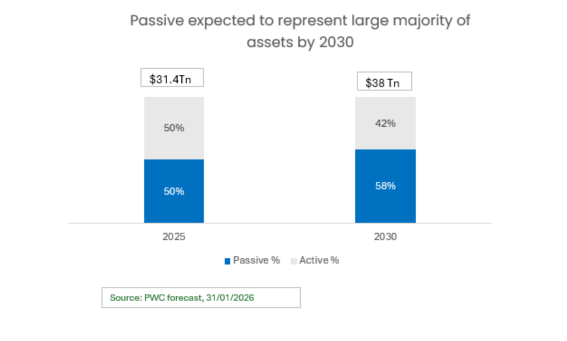
Au cours des dernières décennies, le secteur financier a été profondément marqué par la montée en puissance régulière de l’investissement passif. PwC prévoit que d’ici 2030, les fonds passifs pourraient représenter 58 % du total des actifs du secteur des fonds communs de placement/ETF américains[1]. Les distorsions de prix engendrées par ce phénomène peuvent se transformer en opportunités d’investissement.
Deux moteurs de performances complémentaires
Les stratégies neutres au marché de Candriam s’appuient sur deux sources de rendement distinctes, chacune ciblant différents types d’inefficiences du marché.
Premièrement, les événements de rééquilibrage des indices, qui déclenchent d’importantes entrées et sorties de capitaux, susceptibles de provoquer des distorsions temporaires des cours. Notre équipe d’investissement suit de près ces événements dans le but de générer des rendements en combinant des positions longues et courtes sur des actions cotées en bourse.
Deuxièmement, les opportunités de valeur relative, qui découlent des écarts de valorisation entre les titres. En identifiant les valeurs qui semblent relativement surévaluées ou sous-évaluées, la stratégie vise à tirer parti de la normalisation de ces écarts au fil du temps.
Ces opportunités sont renforcées par l’essor continu de l’investissement passif, qui peut accentuer les décalages de valorisation et élargir l’éventail global des opportunités.
Recherche d’un rendement stable dans des environnements de marché difficiles
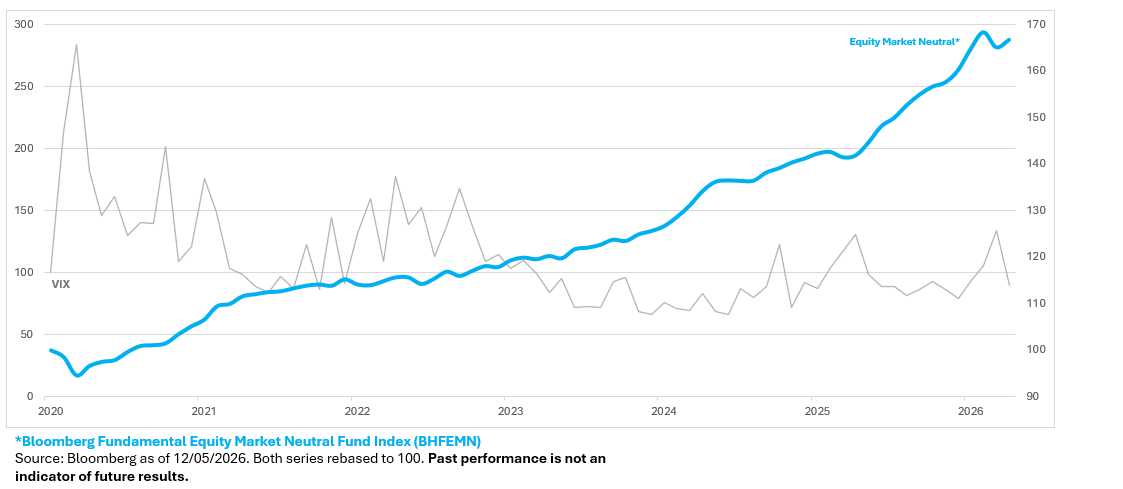
Les stratégies neutres au marché sont conçues pour réduire la dépendance à l’orientation globale du marché en se concentrant sur les opportunités de valeur relative. Bien que la volatilité des marchés actions puisse varier considérablement au fil du temps, la stratégie cherche à maintenir un profil de rendement plus stable, en tirant parti des inefficiences de valorisation plutôt qu’en suivant les fluctuations générales du marché.
Stratégies quantitatives multifactorielles : L'objectif est de générer un alpha stable en combinant l'analyse financière quantitative et l'analyse ESG.
Notre stratégie ESG market neutral vise à combiner des positions à l’achat sur des sociétés aux fondamentaux solides, et dotées de solides références en matière environnementale, sociale et de gouvernance (ESG), avec des positions à la vente sur des sociétés dont la situation financière est moins bonne et dont les scores ESG sont plus faibles. En équilibrant ces positions, nous visons à capturer l'écart de rendement entre les deux sociétés, qui devrait être positif au fil du temps et largement décorrélé des classes d'actifs traditionnelles. Notre processus d'investissement systématique nous permet d'intégrer de manière transparente les indicateurs ESG et financiers, dans le but de générer de la valeur à long terme - une approche que nous jugeons à la fois originale et convaincante.

Alors que les stratégies de rebalancement d'indice et de valeur relative sur indice sont généralement mises en œuvre par des fonds multi-stratégies ou des sociétés de trading pour compte propre, nous les avons regroupées sous la forme d'un fonds UCITS avec une liquidité quotidienne.

Nos stratégies market neutral sont assorties de niveaux distincts de volatilité cible pour répondre aux différents besoins des investisseurs.

Les stratégies long/short sur actions peuvent contribuer à stabiliser la performance d'un portefeuille lorsqu'elles sont combinées à d'autres classes d'actifs telles que les actions et les obligations. En effet, leur faible corrélation historique avec la plupart des actifs traditionnels, y compris dans les baisses de marché, a un effet de lissage sur les fluctuations du portefeuille. Ils peuvent également contribuer à réduire le risque du portefeuille.
Voulez-vous en savoir plus sur nos fonds Stratégies market neutral ?

En savoir plus sur nos publications ?
Principaux risques liés aux stratégies
- Risque de perte en capital
- Risque actions
- Risque lié aux instruments financiers dérivés
- Risque de contrepartie
- Risque d’arbitrage
- Risque de durabilité